
Treat a material substitution on a pull-back dinosaur carrier as like-for-like only after confirming the affected component, retained play functions, and agreed acceptance criteria. For Yiwu mixed-carton OEM sourcing, keep the carrier, its two mini cars, and its light-and-music configuration tied to one specification revision. Approve a demonstrated equivalent; require version re-approval when appearance, fit, function, or packaging changes; use a development route when the proposal needs engineering validation. Record who decides and what must close before production.
Start with the assortment choice: a carrier with included cars serves a different play purpose from a parking-and-slide vehicle set. A cheaper substitute material is not an equivalent offer if it changes the product configuration you selected.
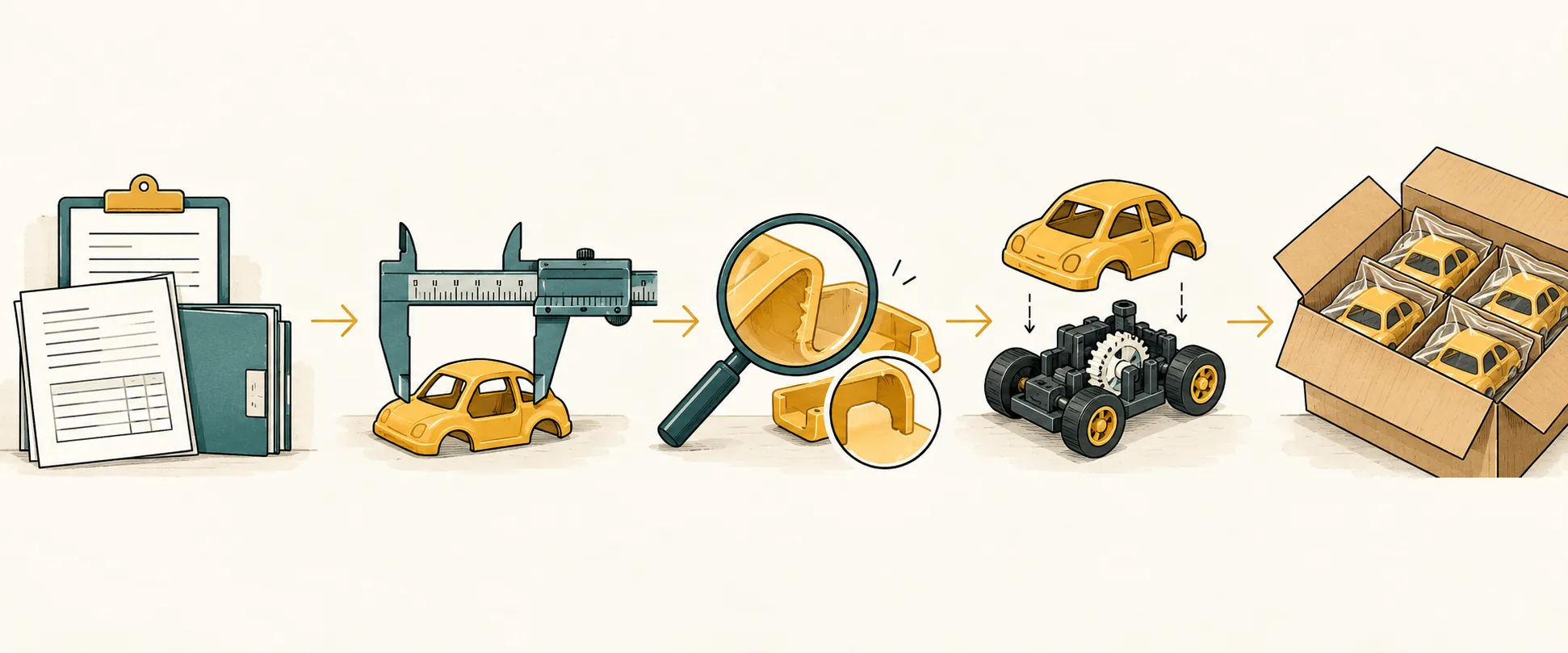
Which catalog configuration are you changing?
| Pull-back dinosaur storage carrier | Catalog identifier: YT271351. Described configuration: dinosaur car-storage carrier with light and music and two mini cars. Recorded material: plastic. Packing: color box. Reference MOQ: 1. Recorded units/carton: 24. Request confirmation of which vehicle has the pull-back mechanism, the exact contents of one quoted unit, and which component the proposed material change affects. |
|---|---|
| Die-cast parking-and-slide vehicle play set | Catalog identifier: YT302890. Described configuration: parking/slide play set with die-cast toy vehicles. Recorded materials: plastic and metal. Packing: color box. Reference MOQ: 5. Recorded units/carton: 96. Request the component-level material breakdown and exact set contents; the material field does not establish which parts are metal. |
| Selection consequence | Choose the carrier when the assortment calls for vehicle transport/storage with included mini cars. Choose the parking-and-slide set when the assortment calls for a vehicle play environment. Assess material changes within the selected configuration rather than treating the two products as equivalent quotations. |
| Commercial confirmation | Ask the supplier to state the sales unit against each reference MOQ and carton quantity. Neither reference MOQ establishes a custom-color minimum, and neither carton quantity establishes a mandatory order multiple. |
Is the proposal a substitution, a revised version, or new development?
Classify the proposal by what changes physically and what must be demonstrated, not by whether the supplier calls it OEM, private label, or an equivalent material.
Use like-for-like approval only when the supplier identifies the original and proposed material at component level and the comparison supports your agreed requirements. A catalog description of “plastic” is not a resin-grade specification. For the carrier, ask whether the change touches the outer shell, storage closure, wheels, pull-back assembly, or light-and-music housing; do not assume the same material serves all of them.
Treat a deliberate change to appearance, feel, fit, decoration, or packing as a revised version requiring approval of the affected fields. Move to a development route when the proposal needs engineering work to establish geometry, interfaces, mechanism performance, or manufacturability.
A small-looking change can affect a molded moving feature or fit and require tooling work, while a color, logo, label, or packaging change may avoid it. Ask for a part-specific tooling explanation rather than accepting either a blanket tooling charge or a blanket promise that no tooling is needed. Toy Mold & Cost Guide
Which supplier answers determine the material-change decision?
| What exactly changes, and against which baseline? | Request the product identifier, order/specification revision, component name, original material designation, proposed designation, and reason for substitution. Hold the change decision if the supplier cannot identify what is being replaced; this does not invalidate other evidence already accepted for unchanged parts. |
|---|---|
| Which play functions and interfaces could be affected? | For the carrier, compare the proposed part with the baseline for car access and retention, closure operation, rolling or pull-back operation where applicable, and light/music operation. For the parking set, identify affected vehicle-to-slide and assembly interfaces. Record the target and observed result separately. |
| Does the change need tooling or process work? | Ask whether dimensions, wall sections, molded features, assembly settings, decoration adhesion, or fixtures change. Request the affected drawing and proposed validation route. Route unresolved engineering changes to development rather than approving them as a simple substitution. |
| Which sample will demonstrate the changed configuration? | Request a stock sample to establish the baseline where useful, then a changed-material sample carrying the requested decoration and packaging when those features are affected. Identify each sample separately so approval of the baseline is not mistaken for approval of the new version. |
| How will color and logo acceptance be judged? | Specify the physical color reference or color-system reference, viewing or measurement method, acceptance tolerance, logo artwork revision, location, dimensions, and application process. A signed sample alone does not define a numerical tolerance. |
| What changes commercially for this exact configuration? | Request the current price and quoted unit, material-change MOQ, color allocation, logo and packaging minimums where applicable, sample charges, and production timing. Ask for included and excluded charges. Keep each constraint attached to its route instead of transferring the base catalog MOQ to customization. |
| How will the version be identified in mixed cartons? | Confirm unit-pack contents, inner packing, actual units per carton, carton assortment, and the identifier connecting each unit or inner pack to its version. Specify whether old and revised versions may share a carton. Ask how shortages or substitutions will be reported before dispatch. |
| What evidence covers the changed construction and intended destination? | Have the responsible technical/compliance reviewer compare the proposed construction, intended users, functions, and destination with the supporting reports and documents. Request additional assessment where coverage needs clarification; do not impose an automatic new-test rule merely because an internal identifier or batch changes. |
How should stock, color, logo, and packaging routes be quoted?
Request separate offers for the unchanged configuration and each requested customization route, using the same sales unit and set contents throughout.
For the dinosaur carrier, ask the supplier to confirm a quotation unit comprising the carrier and two mini cars in one color box. Compare an unchanged offer with a color-only offer, then the requested material/color/logo/packaging configuration. If an offer changes the included cars or packing contents, mark it as a different configuration rather than a lower price for the same unit.
Ask which colors are available for the proposed quantity now, what allocation is offered, and whether the same material and color can be reordered. A listed color does not establish inventory or immediate shipment. Obtain fresh availability confirmation when placing a reorder.
Separate the toy production minimum from any logo-process or custom-box minimum that actually applies. Packaging can change minimum quantities and cost even when the toy stays unchanged; ask whether unused printed packaging must be purchased, stored, or handled under another agreed arrangement. Do not infer that a carton quantity forces full-carton ordering. Toy Mold & Cost Guide
What should one linked customization request contain?
| Product, quoted unit, and order revision | Product identifier: YT271351. Requested quotation unit: one dinosaur carrier with two mini cars in one color box, subject to supplier confirmation. Proposed order specification: CARRIER-B, replacing baseline CARRIER-A. Quote the same contents for the unchanged and customized routes. |
|---|---|
| Proposed material change | Request assessment of a substitute resin for the outer carrier shell only. Supplier to identify the baseline and proposed resin designations and confirm all other components that remain unchanged. No dimensional or mechanism changes are authorized by this request. |
| Color reference and tolerance | Target: buyer-held physical swatch BLUE-01. Proposed visual acceptance criterion: no visible mismatch in a side-by-side comparison under an agreed D65 viewing setup, accepted by the buyer's designated approver. If instrumental acceptance is required, agree the measurement method and numerical tolerance before sampling; do not infer them from the swatch or signature. |
| Logo location and process | Requested process: pad printing, subject to supplier feasibility confirmation and a print trial on the proposed shell material. Location and dimensions: drawing LOGO-B. Do not move the logo, change the process, or add molded branding without written revision. |
| Packaging artwork and wording | Retain a color-box format; develop artwork BOX-B around the confirmed contents. Include the buyer brand, product description, contents statement, barcode, and destination-specific wording accepted by the responsible reviewer. Confirm the chosen printer's file format, dieline, bleed, and proof requirements rather than treating them as universal toy specifications. |
| Quantity and mixed-carton request | Request separate current minimums for the unchanged unit, changed shell/color, logo application, and custom box wherever those constraints apply. Ask whether the catalog packing of 24 units per carton will be retained and whether partial or mixed cartons are accepted. Require version identification on the packing list and agreed pack markings. |
| Samples and change control | Use baseline sample BASE-A for comparison. Request decorated, changed-material pre-production sample PP-B with packaging proof BOX-B. Record sample identifiers, photographs, specification revision, and the approved change scope. Require written authorization for any further substitution before production. |
Which sample is sufficient to approve the change?
Approve the change using a sample that contains the changed features; a blank stock sample cannot demonstrate an unmade material, color, logo, or packaging configuration.
A stock sample is useful for establishing product identity and baseline operation. A decorated or pre-production sample may be needed to demonstrate buyer-specific changes. For the hypothetical shell substitution, compare the changed shell in the assembled carrier, not just a loose resin chip, and inspect the requested print on that substrate. Private Label Toys Guide
Define the checks before judging the sample: specified target, inspection method, observation, and acceptance result. Commercial checks of fit, appearance, contents, and operation do not replace applicable safety assessment.
As a purchasing control, approve the specification and reference sample before mass production, and have supporting reports reviewed against the exact construction and destination. A sample record provides traceability; it neither defines unstated tolerances nor proves that an undisclosed substitution cannot occur. Yiwu Wholesale Guide
What does a completed conditional material-change record look like?
| Identity and revision | Product identifier: YT271351. Change record: MC-01. Baseline specification: CARRIER-A, sample BASE-A. Proposed specification: CARRIER-B, planned sample PP-B. Scope: outer-shell resin substitution plus the requested color, logo, and box artwork. |
|---|---|
| Specified target | Retain the carrier-and-two-car configuration and baseline mechanisms. Meet BLUE-01 visual acceptance, LOGO-B placement/process, and BOX-B approved contents and wording. Any proposed geometry change requires a separate revision. |
| Supplier answer and observation status | Hypothetical supplier response: shell substitution proposed; grade comparison and changed-material sample to follow. Baseline configuration is identified, but no observation of the proposed assembled version is recorded. Color, print, fit, function, and packaging acceptance remain pending. |
| Decision | Conditional approval to prepare the specified sample and packaging proof only. Mass production and substitution into the mixed-carton order are not authorized. |
| Responsible decision-maker and date | Buyer technical approver, acting as the designated approval role in this hypothetical example. Decision date: October 27, 2026. A live record must identify the responsible individual by name. |
| Conditions, owners, and due point | Supplier technical contact: submit material identities and change scope before sample acceptance. Buyer quality approver: record target-versus-observation results for PP-B. Buyer artwork/compliance reviewer: accept BOX-B wording and relevant evidence coverage. Buyer purchasing owner: accept the revised quote, minimums, packing, and reorder terms. All conditions are due before production release. |
| Follow-up closure | Status: open; sample preparation only. Closure requires accepted evidence references, the responsible approver's name and acceptance date for each condition, and a final signed production-release decision against CARRIER-B. If the proposal changes again, revise MC-01 rather than silently closing the earlier scope. |
When should the buyer approve, conditionally approve, or reject?
Approve when the proposed configuration meets the agreed requirements and the responsible approver accepts the evidence; conditionally approve only a clearly bounded next step; reject when the demonstrated change fails a non-negotiable requirement.
An unresolved material identity or untested proposed sample is a reason to hold production approval, not proof of supplier dishonesty or inevitable product failure. If the changed shell cannot meet the agreed fit, color, or print requirement, reject that proposal or issue a new development brief.
Keep the decision specific to the item and order revision. Approval of one carrier shell does not approve a material change in the parking set—or authorize an unnamed substitute in the next mixed carton.