
A six-year-old lifts a bubble machine off the patio table, tips it 40 degrees to show a friend, and sets it down. Ten seconds later the wand stops throwing bubbles, or worse, a thin film of solution runs out of the battery door. For a bubble machines wholesale buyer, that 10-second tilt is the whole design review: reservoir placement decides where the liquid goes, battery-door construction decides whether it stays out of the cells, and carton orientation decides whether the unit arrives dry.
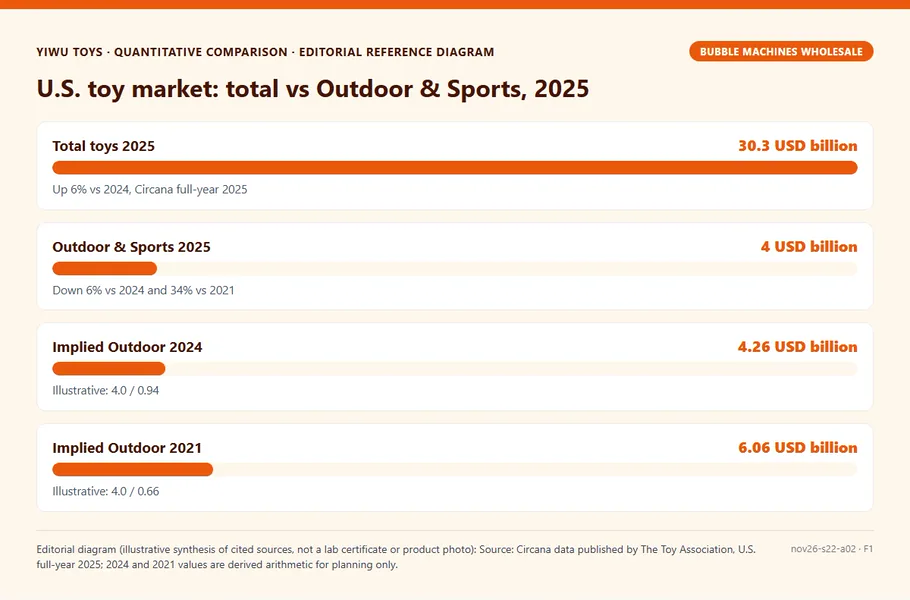
The category context argues for discipline over volume. U.S. retail toy sales reached quotation on request billion in 2025, up 6% vs 2024, while Outdoor & Sports Toys fell 6% to quotation on request billion and sat 34% below 2021, per data published by The Toy Association. January–September 2026 read shows total toy dollars up +20% and units up +18%, with the largest declines still concentrated in outdoor, active and seasonal play. Bubble machines sit next to that soft segment, so a first order belongs in a controlled seasonal test with sample-verified leak and packing specs.
This review covers three mechanical questions a buyer can settle on a sample: top-feed vs bottom-sump reservoir geometry under tilt, battery-compartment sealing details, and carton upright orientation as an order-stage packing instruction. No source in this set supplies bubble-machine airflow or leak measurements, so every design point below is a sample-verification question, not a lab result.
Why reservoir placement decides what happens when a machine is tilted
Two reservoir architectures dominate the wholesale catalogs. A top-feed reservoir holds solution in a tray or tank above the wand and air path, so gravity delivers liquid to the bubble ring. A bottom-sump reservoir keeps the liquid in a chamber at the base, with the pump intake dipping into it from above. At rest both look identical on a product photo. Tilted 30 to 45 degrees, they fail in different places: the top-feed unit sends solution toward the battery bay, the air outlet or the housing seam nearest the lid, while the bottom-sump unit sloshes liquid against the base seam and can starve the intake so the wand runs dry.
The buyer's job is to convert that difference into two written questions per item: what is the intended fill volume in milliliters, and what tilt angle the unit is designed to tolerate without solution reaching the battery compartment or air intake. A supplier answer of 'leak-proof' carries no information. A supplier answer of 'fill to the 120 ml line, battery door sits 25 mm above the reservoir lip, air outlet above the fill line' is a spec you can photograph and check.
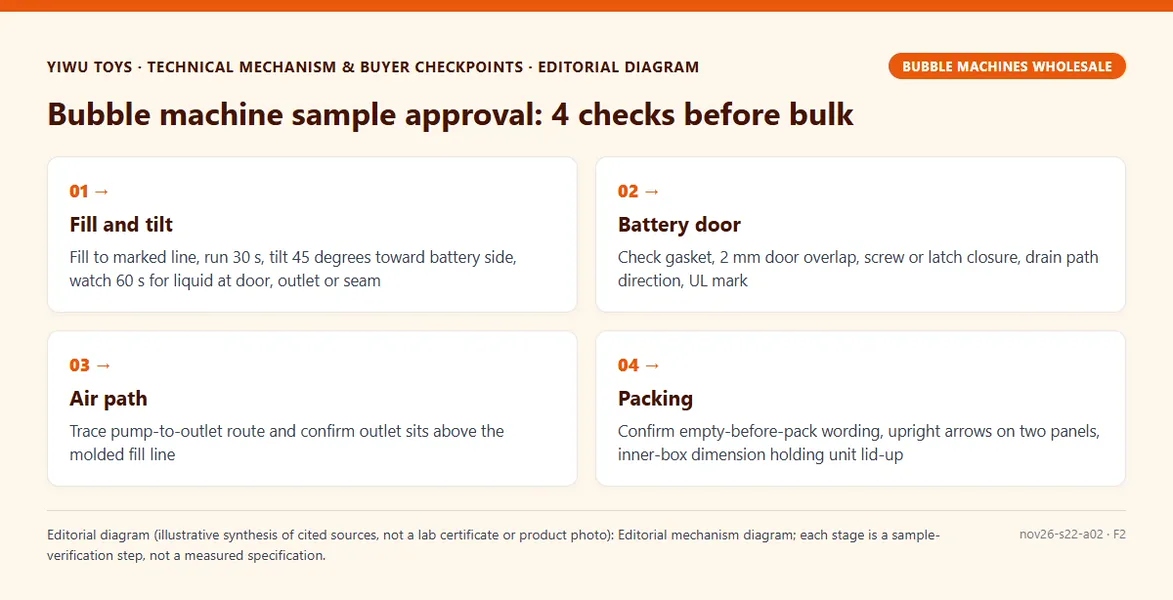
Airflow design ties directly into this. The air pump pushes through an outlet that must sit above the maximum fill line; if the outlet is below the fill line, tilt sends liquid into the air channel and the unit gurgles or stops bubbling. On the sample, trace the air path from the pump to the outlet and mark whether the outlet sits above or below the molded fill line. That single observation separates a workable tooling from one that will generate returns in the first week of summer.
Top-feed reservoirs: what to look for on the sample
A top-feed unit puts the reservoir lip close to the battery door by design, because both sit in the upper housing. On the sample, measure the vertical distance between the reservoir lip and the nearest edge of the battery door opening in millimeters. A 20 mm gap and a 40 mm gap behave differently under a 45-degree tilt, and the number belongs in your sample-approval record next to a photo.
Check the overflow path. If the reservoir has a molded overflow notch, confirm where it drains: onto the ground away from the battery bay, or into the lower housing where it can pool. Confirm the fill-line marking is molded, not a sticker that peels after 10 wash cycles. Confirm the lid gasket or lip seal seats without a gap when the lid is closed, and check whether the lid latches or merely rests.
Finally, run the tilt sequence yourself: fill to the marked line, run the machine 30 seconds, tip it 45 degrees toward the battery side, hold 5 seconds, set it upright, and watch for 60 seconds. Record whether solution appears at the battery door, the air outlet or the seam. That sequence is the sample test; the written confirmation of the same construction in bulk is the order spec.
Bottom-sump reservoirs: the trade-offs buyers should price in
A bottom-sump design keeps the reservoir away from the upper housing, which reduces the chance of solution reaching the battery bay on tilt. The trade-off moves to the base: liquid sits against the base seam and around the pump intake, and a unit stored or shipped with residual solution can weep at that seam. On the sample, inspect the base seam for a gasket, an ultrasonic weld line or a snap fit, and note which one you
Write the empty-before-pack instruction into the order specification. A sump that ships with 50 ml of residual solution puts that liquid against the base seam for the entire transit, and a carton laid flat turns the base seam into the lowest point. The instruction belongs on the inner box and in the order specification, not only in a verbal handover.
The pump intake position is the second check. If the intake sits 5 mm above the base floor, a 10-degree tilt on uneven ground can starve it; if it sits flush, it can pull sediment. Note the intake height in millimeters and the intended minimum operating fill. Both numbers go into the sample-approval sheet so a replacement shipment can be compared against the approved unit.
Top-feed vs bottom-sump: sample checks and packing implications
Every cell below is a verification item to confirm on the sample and in writing per item; none is a measured specification claim.
| Reservoir type | What tilt exposes | Packing implication | Sample checks to request | Where solution sits at rest |
|---|---|---|---|---|
| Top-feed | Battery bay, air outlet, upper housing seam | Empty before pack; upright carton; inner box holds unit lid-up | Lip-to-battery-door gap in mm; molded fill line; overflow drain path; lid gasket seat; 45-degree tilt sequence | Tray or tank above wand and air path |
| Bottom-sump | Base seam, pump intake, lower housing | Empty before pack; upright carton; base seam not load-bearing in transit | Base seam type (gasket, weld, snap); intake height in mm; minimum operating fill; empty-before-pack wording | Base chamber below pump intake |
| Either design | Battery door and air outlet in both cases | Orientation arrows on carton; inner-box fit confirmed per item | Gasket presence and fit; door overlap past opening; screw vs latch closure; drain channel routing | Per item drawing |
| Either design | Air outlet below fill line in either design | Upright orientation marked on master carton and inner box | Air outlet position relative to molded fill line; pump-to-outlet path traced on sample | Per item drawing |
| Either design | Loose battery door or thin shell | Battery door secured or batteries excluded per item confirmation | Sturdy plastic check; part retention; UL mark on electric toy; battery door security | Per item drawing |
Battery compartment sealing: what a sample can actually prove
A battery door is the weakest point on any liquid-adjacent toy, and the sample tells you most of what you need in under 5 minutes. Open the door and look for a gasket: an elastomer ring, a molded lip or a foam strip. Check that the door overlaps the opening by at least 2 mm on every side, that the closure is a screw or a firm latch rather than a friction tab, and that any drain channel routes spills away from the cells rather than into them.
AAP guidance supports the physical checks: buy sturdy plastic because thin plastic can break into sharp pieces, confirm parts are attached tightly, and confirm electric toys carry a UL mark. AAP also flags button and lithium coin batteries as loose small-object hazards if they come free, which makes battery-door retention a first-order check rather than a cosmetic one. On the sample, press the closed door firmly and try to lift an edge with a fingernail; a door that lifts is a door that will open in a bag.
Record what you gasket type, door overlap in millimeters, closure type, drain path direction, UL mark location. Then write the same construction into the bulk order specification, item by item. That written spec, item by item, is the only bridge between a good sample and a consistent shipment.
Carton upright orientation and leak-resistant packing
A carton laid flat in a container or a warehouse turns a minor residual drip into a battery-door soak. The fix is an order-stage instruction, not a shipping afterthought: 'This side up' arrows printed on two adjacent panels of the master carton, matching arrows on the inner box, and a written empty-before-pack requirement for every unit. Confirm all three per item and per destination before production.
Inner-box fit matters as much as the arrow. A unit that shifts 15 mm inside a loose inner box can rotate onto its side even when the master carton stays upright. Ask for the inner-box internal dimension in millimeters against the unit's widest point, and confirm the unit is restrained lid-up. A molded pulp or corrugated cradle that holds the base and the lid separately is the packing detail to photograph at pre-production.
Here is an illustrative planning example, not a quote: a 500-unit first order packed 24 units per carton yields 500 / 24 = 20.83, so 21 cartons, with 4 units in the last carton. If the approved inner box holds 6 units and the master holds 4 inner boxes, the same 500 units need 21 master cartons with a partial final inner box. Run that arithmetic before you approve the packing drawing, because the carton count drives pallet height, container fill and the orientation labels you need printed.
The U.S. compliance frame for a bubble machine sample
Under U.S. product safety documentation Section 106, ASTM F963 is a mandatory consumer product safety standard for children's toys, codified at 16 C.F.R. part 1250. CPSC third-party testing and a Children's Product Certificate apply to products designed or intended primarily for children 12 years of age or younger, while ASTM F963 scope covers toys for children under 14. Age grading therefore decides the test path: a 3+ bubble machine sits inside the CPC frame, and a 13+ item may still fall within ASTM F963 scope but would not require third-party testing or a CPC under CPSC's 12-and-under certification trigger.
This frame is U.S.-specific. EU, UK and other destination requirements sit outside this evidence set and need separate confirmation per market. The order specification should name the destination, the age grade and the test scope per item, and the sample-approval sheet should carry the same three fields so the certificate path is traceable.
Sizing a first bubble-machine order against a soft outdoor segment
The category math argues for a controlled test rather than a volume bet. As an illustrative planning example using the 2025 figures, Outdoor & Sports share of total toy dollars is 4.0 / 30.3 × 100 = 13.20%; the implied 2024 outdoor value is 4.0 / 0.94 ≈ quotation on request billion; and the implied 2021 outdoor value is 4.0 / 0.66 ≈ quotation on request billion. The segment is roughly 13% of the U.S. market and about a third smaller than in 2021.
January–September 2026 release reinforces the point: total toy dollars up +20% and units up +18%, with the largest declines in outdoor, active and seasonal play. Growth is coming from collectibles and fandom, not from the shelf where a bubble machine sits. A buyer can still carry the item, but the order size should follow confirmed sell-through and a sample-verified leak and packing spec, not a forecast built on the total-market number.
The holiday read adds a second planning input: 2026 U.S. Holiday Purchase Intentions Study surveyed 3,534 consumers, found expected holiday spending averaging quotation on request versus quotation on request last year, and forecast fourth-quarter 2026 holiday spending in a range from a 1% decline to a 2.5% increase versus 2025. That arithmetic is U.S.-only and year-bounded. It does not transfer to EU, UK or Mexican retail, and it is a planning frame rather than a demand forecast for any single item.
Age grading and active-play context for the bubble-machine brief
Bubble machines are active-play items, and the public-health context for active play is well documented. WHO reports that 31% of adults and 86% of adolescents do not meet recommended physical activity levels, and that physical inactivity is projected to cost public health care systems nearly USquotation on request billion between 2020 and 2030. WHO's 2019 guidelines for children under 5 recommend active play several times a day and no more than 1 hour of restrained time at a stretch for infants. Those figures frame the category as outdoor, movement-oriented play rather than a screen substitute.
Age grading in the catalog should match the developmental bands that public guidance uses. 'Good Toys for Young Children by Age and Stage' lists large rings and squeeze toys for infants birth through 6 months and plastic and wood vehicles with wheels for older infants 7 to 12 months. Parenting suggests indoor activities such as peek-a-boo for babies 0–9 months and a box car for toddlers 1–2 years. AAP guidance in advises matching toys to a child's developmental stage and cautions that 'educational' labels on tablets, computer games and apps are often not supported.
For a bubble machine, the practical output is a printed age band on the inner box and the master carton that matches the CPC test scope and the destination market. A 3+ label on a unit tested under the 12-and-under CPC frame is internally consistent; a 3+ label on a unit with no test scope named is a documentation gap. The sample-approval sheet should carry the age band, the test scope and the destination in three adjacent fields.
Do top-feed or bottom-sump bubble machines leak less when tilted?
Neither design is inherently leak-free; the difference is where the solution travels. A top-feed unit can send liquid toward the battery bay or air outlet on a 45-degree tilt, while a bottom-sump unit can pool at the base seam or starve the pump intake. Run the 45-degree tilt sequence on the sample, record where liquid appears, and write the intended fill line and tilt tolerance into the order specification.
How do I check battery compartment sealing on a wholesale sample?
Open the door and check four physical details: a fitted gasket, door overlap of at least 2 mm past the opening, a screw or firm latch closure, and a drain path that routes spills away from the cells. AAP guidance also supports checking sturdy plastic, tight part retention and a UL mark on electric toys, and flags button and lithium coin batteries as loose small-object hazards. Photograph each detail and write the same construction into the bulk order specification.
Why does carton upright orientation matter for bubble machines?
A carton laid flat in transit or storage puts residual solution against the battery door or base seam instead of letting it drain away. Specify 'This side up' arrows on two adjacent master-carton panels, matching arrows on the inner box, an inner-box dimension that restrains the unit lid-up, and an empty-before-pack instruction. Confirm all four per item and per destination at order stage rather than reading them off a catalog photo.
Turn these checks into a bubble-machine order specification
Start with the sample, not the catalog photo. Fill to the marked line, run 30 seconds, tilt 45 degrees toward the battery side, and photograph where liquid appears. Record the lip-to-door gap in millimeters, the gasket type, the door overlap, the air outlet position against the fill line, and the inner-box dimension that holds the unit lid-up.
Then write the order specification item by item: intended fill volume, tilt tolerance, empty-before-pack wording, carton orientation arrows, packing quantity per inner box and master carton, age grade and destination. Yiwu Toys works as a sourcing and catalog desk, so quantities, customization, lead times and documentation are confirmed per item and destination before production. Browse the Bubble Toys category to shortlist models, then bring this checklist to the sample review.