
Advance a steam-and-light kitchen set or light-and-music delivery-truck building set on assortment fit and comparable packed-unit cost—not catalog price alone. For Yiwu mixed-carton sourcing, compare each exact product version using its current goods quote, packing configuration, carton volume, weight, and allocated delivery costs. Then reconcile the final closed cartons against the approved packing specification and packing list before accepting the cost basis.
Treat a shipment containing several single-item carton types differently from a carton containing several items. Both need item-level costing, but a genuinely mixed carton also needs a contents record showing how many units of each item occupy that carton.
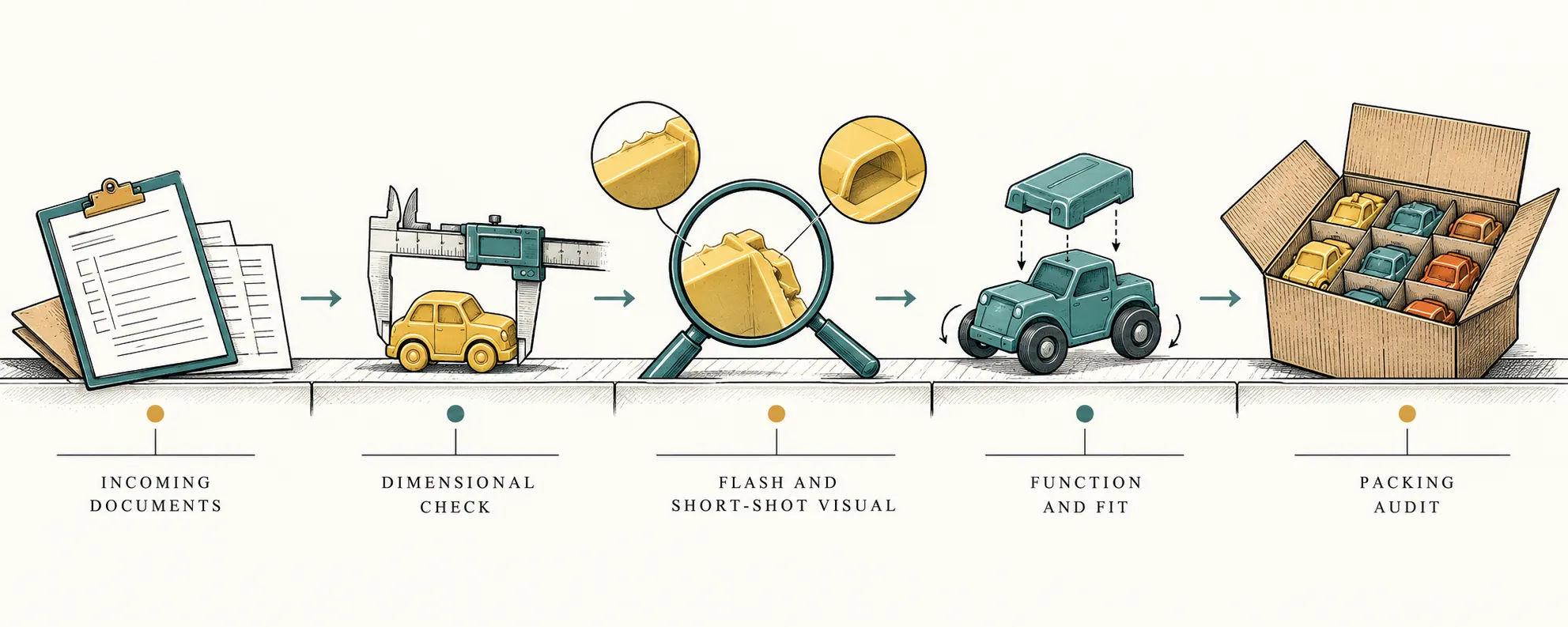
Which Catalog Details Support the Initial Toy Comparison?
| Steam-and-light pretend-play kitchen set | Catalog description: kitchen set with steam and light-up features. Recorded material: plastic. Retail packing: color box. Recorded quantity: 18 units/carton. Reference price: USquotation on request Recorded size: 25.5 × 14 × 34.5 cm; recorded weight: 5.0 kg. Confirm the price's sale unit and what the size and weight describe before using them in a freight calculation. |
|---|---|
| Light-and-music delivery-truck building set | Catalog description: delivery-truck building set with light and music. Recorded material: PP plastic. Retail packing: window box. Recorded quantity: 48 units/carton. Reference price: USquotation on request Recorded size: 19.5 × 13 × 14 cm. Request the closed shipping-carton dimensions and gross and net weights in kilograms. |
| Initial selection decision | Advance the kitchen set to sample and quote review for a cooking-role-play assortment; advance the delivery-truck set for a vehicle-building assortment. For either choice, confirm the described mechanism and included contents with the sample. The lower reference price alone does not establish the lower landed cost. |
What Must Be Agreed Before the Purchase Order?
Before the purchase order, obtain a proposed packing specification and an itemized quote for each selected version; after packing, replace estimates with measured results.
Ask the supplier to identify the product and version, retail pack, units per shipping carton, any mixed-carton contents, proposed external carton dimensions with units, gross and net weights with units, carton construction, and shipping-mark revision. Include the quote currency, price unit, order quantity, and charges included or excluded.
Keep these as proposed values until packed measurements are available. A publisher's landed-cost guidance similarly recommends requesting carton dimensions, gross weight, destination, and tax assumptions before comparing quotes. Landed Cost Calculator
Define the delivery endpoint and buyer-set cost ceiling in the worksheet. Keep destination-specific tax estimates and paperwork review separate from the physical carton inspection. Agree measurement tolerances and the action required when a result falls outside them; a small dimensional difference is not automatically a rejected shipment.
What Should Each Item's Landed-Cost Worksheet Contain?
| Steam-and-light kitchen set — worksheet row | Catalog baseline: USquotation on request reference price; color box; 18 units/carton. Quote inputs: record current price per confirmed sale unit, quantity, packing revision, proposed carton count, external dimensions, and gross/net kg. Final observations: enter measured carton data and reconciled unit count. Cost result: calculate the low/high per-unit estimate using the selected freight allocation rule. Proposed decision: advance to sample/itemized quote for cooking-role-play fit; hold cost approval until the quote and packing basis are accepted. |
|---|---|
| Light-and-music delivery-truck set — worksheet row | Catalog baseline: USquotation on request reference price; window box; 48 units/carton. Quote inputs: obtain the current sale-unit price, agreed quantity, external carton dimensions, gross/net kg, carton count, and packing revision. Final observations: enter measured data and the reconciled count. Cost result: calculate the low/high per-unit estimate on the same delivery and currency basis as the kitchen set. Proposed decision: advance to sample/itemized quote for vehicle-building fit; hold cost approval until the packed-cost inputs are accepted. |
| Shared worksheet columns | Include item/version identifier, catalog snapshot date, quote revision/date, packing revision, agreed order quantity, confirmed versus provisional inputs, cost range, allocation basis for each shared charge, buyer-set cost ceiling, advance/hold decision, responsible approver/date, and follow-up owner and closure evidence. |
How Should Shared Freight Be Allocated Across Items?
Allocate each shared charge by its cost driver, and apply that rule consistently across the shipment.
For volume-priced freight, use each item's share of verified shipment CBM. For weight-priced transport, use the weight basis used in the quotation. A quantity split is a reasonable buyer choice for similarly sized and weighted units; a declared-value split may suit a value-based commercial fee. The publisher suggests quantity, value, or cubic volume as allocation options, not as a compulsory standard. Landed Cost Calculator
For a true mixed carton, allocate that carton's volume using a documented packing layout or occupied-space estimate whose shares sum to the whole carton. Do not charge the full carton volume to every item. Where the split is only an estimate, label it provisional and check whether a different reasonable split changes the shortlist decision.
Keep item-specific duty and tax estimates on their own item lines rather than spreading them by cube simply because freight uses cube. Record tax cash outlay separately from the purchasing cost comparison if the buyer's accounting treatment distinguishes them. Never add a charge again when it is already included in the quoted total.
What Should Be Inspected on the Final Closed Shipping Cartons?
| 1. Carton identity and configuration | Inspect: carton IDs, item/version references, retail-pack configuration, and mixed-content designation. Compare: approved packing specification, pack-out record, and final packing list. Failure signal: an unexplained version or packing change, duplicate ID, or carton that cannot be matched to a list entry. Next decision: segregate affected cartons, establish their contents, and correct the record or repack before approval. |
|---|---|
| 2. External dimensions and measurement units | Inspect: the closed carton's maximum external length, width, and height, including bulging; record units explicitly. Compare: proposed dimensions and buyer-agreed tolerances. Failure signal: dimensions outside the agreed tolerance or an unexplained unit mismatch. Next decision: remeasure, determine whether repacking is needed, and recalculate volume and the freight estimate before accepting the change. |
| 3. Carton and unit counts | Inspect: closed-carton tally by ID, full and part-carton designations, and mixed-carton contents records. Compare: purchase-order quantity, pack-out record, and final packing list. Failure signal: missing or duplicate cartons, inconsistent contents, or a unit total that does not reconcile. Next decision: recount; authorize controlled opening where needed; correct the shipment or obtain approval for a documented quantity variation. |
| 4. Gross and net weights | Inspect: gross weight of closed cartons on an identified scale; retain the packing record supporting net weight. Record kilograms or the agreed unit explicitly. Compare: approved packing data and packing-list totals. Failure signal: a gross/net mix-up, wrong unit, or unexplained variation beyond the agreed tolerance. Next decision: reweigh, investigate contents or packaging changes, and update the freight calculation. |
| 5. Carton strength and condition | Inspect: visible crushing, wet board, bulging, damaged seams, and closure quality. Compare: approved carton construction and strength specification, supported by the agreed supplier or test records. Failure signal: damaged cartons or an unexplained construction change. Next decision: hold affected cartons for investigation or repacking, then repeat dimension and weight checks. A hand squeeze does not verify board strength. |
| 6. Shipping marks | Inspect: legibility, carton sequence, order/item identifiers, and agreed count and weight information. Compare: approved mark artwork and packing-list entries. Failure signal: conflicting IDs, obsolete artwork, unreadable marks, or counts that disagree with the contents record. Next decision: correct and verify the labels, retaining the revised record. Handle destination-specific labeling requirements in their separate review. |
| 7. Final reconciliation | Inspect: totals for cartons, units, CBM, and gross/net weight, grouped by packing configuration. Compare: final measurements, packing list, and freight quotation inputs. Failure signal: totals that cannot be reproduced or a quote still based on superseded packing. Next decision: issue a revised packing list and cost worksheet for approval before accepting the final packed-cost basis. |
How Does a Carton Measurement Change Affect CBM?
A change in the closed carton's external dimensions changes shipment CBM even when the toy quantity stays unchanged.
Explicitly hypothetical example: a proposed carton measures 60 × 40 × 40 cm. CBM per carton = L(cm) × W(cm) × H(cm) ÷ 1,000,000 = 0.096 m³. For 10 identical cartons, total volume = 0.096 × 10 = 0.960 m³.
If those cartons instead measure 60 × 40 × 42 cm after closing, each is 0.1008 m³ and the 10-carton total is 1.008 m³—an increase of 0.048 m³. These are illustrative dimensions, not measurements of either catalog toy.
Record both the proposed and observed dimensions. Compare the difference with the buyer-agreed tolerance, investigate bulging or a packing change, and obtain an updated transport calculation where relevant. A volume change does not establish a proportional freight-price change: the quotation's billing basis still controls. For different carton sizes, calculate each configuration separately and sum the results.
What Approval Note Closes the Comparison?
| Identity and revision | Record the item/version, order reference, worksheet revision, quote revision, packing-specification revision, and final packing-list revision where applicable. |
|---|---|
| Target versus observation | Show the buyer-set per-unit cost ceiling and packing tolerances beside the quoted cost range and measured results. Identify which inputs remain provisional; do not describe a target as an achieved cost. |
| Decision and conditions | State advance to sample/quote, approve the specified cost basis, or hold the affected line/cartons. Name the condition precisely—for example, acceptance of revised external dimensions and the resulting freight allocation. |
| Approver and closure | Record the responsible approver and date, follow-up owner, required correction or confirmation, closure evidence, and final sign-off date. |