
Choose Yiwu mixed-carton sourcing for a replenishment-first toy program only when each repeat-order version and its closed-carton packing configuration can be specified and checked. A friction-powered fire truck set offers vehicle play; a kitchen-themed backpack set offers pretend play. Shortlist by that assortment role, then approve the version, quantity rule and packing separately. Release the shipment only after actual carton measurements, counts, weights, condition and marks reconcile with the approved order and final packing list.
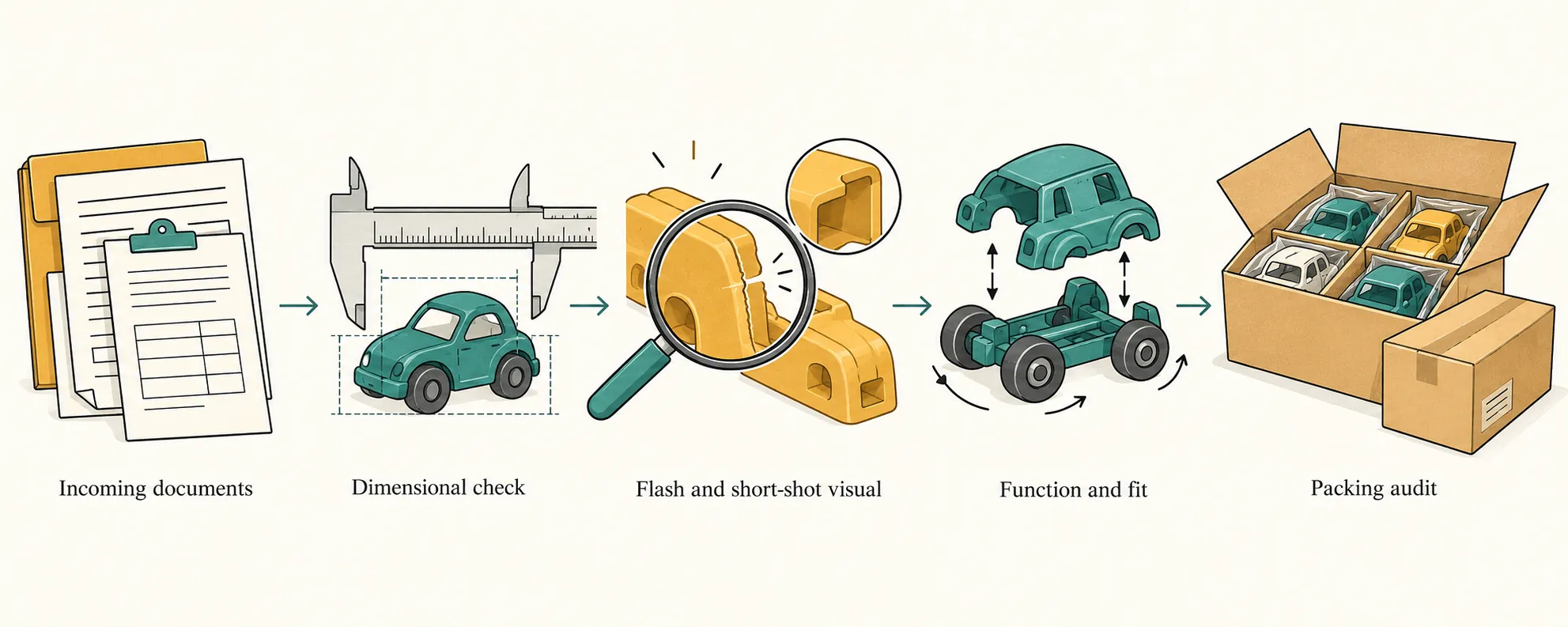
Which Toy Versions Belong on the Replenishment Shortlist?
| YT283799 — themed pretend-play backpack set | Mechanism and role: the recorded name describes a 2-in-1 kitchen/food pretend-play backpack toy and lists doctor, ornaments, colored-clay tools, pets and desserts themes. It does not establish which contents ship together. Proposed core pretend-play candidate only after one theme and contents list are fixed; other themes remain rotation candidates. Catalog-recorded: Plastic; Colour box; 48 units/carton; source size 19.5 × 13.5 × 21.5 cm; source weight 6.0 kg; reference price quotation on request Quantity conflict: the snapshot records MOQ 144, while the brief states 14—current MOQ is to-confirm. Missing/to-confirm: exact theme, component count, inner packing, external carton dimensions, defined gross/net weights and the basis of the source size/weight. Supplier questions: Which contents belong to this exact version? Does 48 mean complete retail sets? May themes share a carton, in what ratio, and with what identification? Tie the approved contents list, sample and packing revision to the buyer SKU. |
|---|---|
| YT338778 — 5-in-1 friction-powered fire truck set | Mechanism and role: friction-powered vehicle play with interchangeable vehicles, as stated in the recorded name. Proposed core non-RC vehicle candidate if the same components and function can be reordered. Catalog-recorded: Plastic; Color box; reference MOQ 108; 36 units/carton; source size 33.5 × 9 × 13.5 cm; source weight 23.5 kg; reference price quotation on request Missing/to-confirm: exact component list, inner packing, external carton dimensions, defined gross/net weights and source measurement basis. Supplier questions: What does 5-in-1 include, and how are the vehicles interchanged? Is every retail box the same version? Does each carton contain 36 complete sets, with loose components secured? Approve the demonstrated mechanism and contents under the buyer SKU. |
| YT302890 — diecast parking-lot vehicle play set | Mechanism and role: the recorded name describes a parking-lot play scene with diecast vehicles and a slide-car element; propulsion and assembly details are not established. Proposed rotation candidate alongside the core vehicle line, avoiding automatic replenishment of an untested scene format. Catalog-recorded: Plastic, Metal; Color box; reference MOQ 5; 96 units/carton; source size 22.6 × 4.8 × 19.5 cm; reference price quotation on request Missing/to-confirm: source weight is absent; also confirm vehicle count, scene pieces, assembly and slide operation, inner protection, external carton dimensions and gross/net weights. Supplier questions: Which parts are metal versus plastic? Which vehicles and scene pieces are included? How are they retained inside the box? Does 96 apply to this exact version, and are split cartons accepted? Link the approved version to the buyer SKU. |
| YT183048 — STEM experiment kit | Mechanism and role: the name establishes an experiment-based science kit, but does not identify any experiment or its operating mechanism. Keep it as a rotation candidate on hold until the supplier demonstrates the activities; do not infer chemistry, circuits or another experiment type. Catalog-recorded: material described as wooden; Colour box; reference MOQ 36; source weight 5.0 kg; reference price quotation on request Missing/to-confirm: units/carton and source size are absent; experiment list, component materials, instructions, consumables, inner packing, external carton dimensions and defined gross/net weights also require confirmation. Supplier questions: What does the buyer assemble or operate in each activity? Which components and consumables are included, and can the kit be reused? How many complete kits fit each carton? Approve the demonstrated activities and contents under the buyer SKU before deciding whether it merits core status. |
| YT255539 — required reference, not yet assessable | Status: to-confirm; no item-specific catalog record for this SKU is supplied in the available extracts. Its mechanism, material, pack type, reference MOQ, units/carton, dimensions and weight cannot be stated. Assortment decision: hold outside both core and rotation selections until the matching record and current sample establish the product and an in-scope shelf role. Request its exact catalog name, mechanism demonstration, version/contents list, material, packing and quantity fields, then assign a buyer SKU and complete the same approval steps. Do not substitute another SKU's specifications. |
What Quantity and Packing Rule Should Each Order Use?
Agree the product version and proposed packing configuration before placing the order. Request the current MOQ, whether it applies per SKU or variant, accepted order increments, units per retail set and complete retail sets per outer carton. A carton quantity is a packing fact, not automatically a full-carton purchasing rule.
If the supplier requires full cartons and the buyer accepts that rule, calculate Q = C × ceiling(max(D, M) ÷ C), where D is the buyer's required units, M the confirmed MOQ and C the confirmed units per carton. Ceiling means round up to the next whole carton. The examples below use reference MOQ alone, without a demand forecast; they are planning quantities subject to supplier reconfirmation and buyer acceptance, not purchase commitments.
Distinguish several single-SKU cartons shipped together from different SKUs or variants physically packed inside one carton. Physical mixing requires a carton-by-carton contents breakdown and agreed variant ratios; it does not automatically waive each item's MOQ. If a rounded quantity exceeds the retail program's need, negotiate an accepted split-carton quantity or hold the item rather than buy surplus merely to fill a carton.
| YT283799 — resolve the MOQ conflict first | Using the snapshot's reference MOQ 144 and 48 units/carton: ceiling(144 ÷ 48) = 3 cartons, or 144 sets. If the brief's MOQ 14 is instead confirmed and full cartons are required: ceiling(14 ÷ 48) = 1 carton, or 48 sets. Neither scenario resolves the conflicting records. Obtain the supplier's current MOQ and accepted increment before selecting the order quantity; reconfirm that 48 applies to the approved theme. |
|---|---|
| YT338778 — provisional minimum full-carton quantity | Reference MOQ 108; recorded 36 units/carton. If full cartons are required: ceiling(108 ÷ 36) = 3 cartons; 3 × 36 = 108 complete sets. Subject to reconfirmation of MOQ, carton count and the exact 5-in-1 version. Larger demand should be rounded using the same accepted increment. |
| YT302890 — carton rounding changes the buying decision | Reference MOQ 5; recorded 96 units/carton. If full cartons are required: ceiling(5 ÷ 96) = 1 carton, or 96 sets—not 5. Subject to reconfirmation. For a rotation trial, ask whether 5 sets or another split-carton quantity is accepted, with what packing and current quote. Hold the item if the only accepted increment exceeds the buyer's need. |
| YT183048 — carton calculation blocked | Reference MOQ 36, but units/carton is missing, so no actual carton quantity can yet be calculated. Explicitly hypothetical method example: if the supplier confirms 24 kits/carton and requires full cartons, ceiling(36 ÷ 24) = 2 cartons, or 48 kits. This is not the SKU's recorded packing. Replace 24 with the confirmed value before approving a quantity. |
| YT255539 — quantity decision on hold | Neither MOQ nor units/carton is supplied. Obtain both, plus the accepted variant and carton-mixing rules, before calculating an order quantity. No executable quantity can be assigned from the available evidence. |
| Packing fields supporting each quantity | Record retail-box contents and component retention, any inner packs, permitted variant ratios, proposed external carton dimensions in centimeters, complete sets/carton, gross and net weight in kilograms, the definition of net weight, carton construction, closure and shipping-mark artwork. Keep catalog size/weight fields separate until their measurement basis is confirmed. |
Which Carton Checks Can Change the Packing Decision?
Agree inspection coverage and measurement tolerances before checking selected closed cartons against the approved packing revision. These are purchasing checks, not product-safety standards. Use the decision triggers below; keep approval ownership, exception closure and final reconciliation in the approval record rather than repeating them in a second checklist.
Quotation-stage carton figures remain planning estimates until production packing is confirmed. Record warehouse measurements separately from proposed values so a packing change remains visible. Mixed-SKU Planning Guide
| Identity or contents cannot be established | Check carton number, supplier reference, buyer SKU, version and packing revision. A sealed carton and its printed quantity do not independently verify contents. If identity, set count or mixed-variant allocation lacks supporting packing-count records, isolate the affected carton and arrange an authorized opening and recount. Reseal it and retain the corrected contents record. |
|---|---|
| Dimensions or weight differ from the target | Measure the external length, width and height of the closed, packed carton in centimeters, including bulges affecting its shipping envelope; weigh gross mass in kilograms using suitable equipment. Compare against agreed tolerances. An unexplained difference triggers remeasurement and investigation of contents or packing, not automatic rejection. Net weight needs the agreed definition and supporting record; do not infer it from closed-carton gross weight alone. |
| Carton construction or condition is unacceptable | Check for crushing, moisture, punctures, split seams, bulging and closure defects, and compare construction with the agreed specification. Appearance or a hand press does not establish stacking strength. Use specified packaging-test evidence where agreed. A damaged or substituted carton may need authorized repair, reinforcement or replacement, followed by new dimensions and weight. |
| Marks do not match the approved allocation | Compare buyer references, carton numbers, variant descriptions, quantities and agreed handling marks with the approved artwork and carton allocation. Correct illegible, duplicate or conflicting marks and their associated records. If the mismatch suggests wrong contents rather than a label error, return to the identity and contents check instead of simply relabeling. |
How Do You Calculate CBM From Final Carton Measurements?
Calculate shipment CBM from the external dimensions of the final packed cartons, grouping only cartons with the same dimensions together.
Explicitly hypothetical example—not a catalog specification: a closed carton measures 60 cm × 40 cm × 35 cm. Its volume is L(cm) × W(cm) × H(cm) / 1,000,000 = 60 × 40 × 35 / 1,000,000 = 0.084 m³. For 12 identical cartons, total volume is 0.084 × 12 = 1.008 m³.
If another carton group has different dimensions, calculate that group separately and add the group totals. Do not multiply one convenient carton's volume by the entire shipment count.
A difference from the pre-order estimate is a review trigger, not an automatic failed shipment. Compare it with the agreed tolerance and investigate whether it reflects measurement variation, changed packing or a different carton configuration. Record approval of an acceptable change; otherwise correct the packing and recalculate.
What Should Happen When a Carton Needs Replacement?
Replace or reinforce a carton only through the agreed exception process, then update every measurement and record affected by that change.
Assign in advance who may authorize replacement and who pays for the carton, repacking and reinspection. This is a commercial responsibility to agree, not a universal rule for Yiwu orders. Sourcing guidance specifically recommends settling replacement authority and cost before shipment. Yiwu Sourcing Agent Checks
Repacking can change dimensions, gross weight, carton count and the distribution of products. Preserve the link between the old carton identity and its replacement, and make obsolete labels unusable. The packing list should retain supplier references as well as carton numbers so the affected goods remain traceable.
Reconcile the purchase order, supplier packing list and warehouse count before loading. Supplier dispatch information alone does not establish warehouse receipt. Close, explicitly approve or exclude unresolved discrepancies before releasing the affected goods. Mixed-SKU Planning Guide
What Is the Approval Sequence and Reorder Record?
| Identity and revision | Enter the purchase-order reference, buyer SKU, supplier item reference, approved product version and sample reference, packing-specification revision, carton numbers and inspection date. |
|---|---|
| Supplier-question and exception log | For each missing field, conflicting value or proposed substitution, retain the question, affected SKU/revision, supplier response, supporting evidence, named owner, due date, buyer disposition and closure date. Reopen version approval when contents, materials or mechanism change. |
| Specified target versus observation | Retain separate entries for proposed and observed dimensions, calculated CBM, carton count, units per carton, gross/net weights, carton construction, closure and shipping marks. Link the measurement and photographic records. Never overwrite a specified target with a measured result. |
| Decision and conditions | Record release, conditional approval or hold for the identified cartons. State each accepted deviation and any correction required before release. Conditional approval does not authorize shipment while its stated conditions remain open. |
| Responsible approver and date | Identify the buyer-authorized approver and approval date for the order specification and, separately, packed-goods release. Assign a named owner and due date to each correction. |
| Follow-up closure | Link the corrected label, revised packing list, recount, remeasurement, replacement-carton record or approved revised version. Record who verified closure and when; keep affected goods on hold if the required closure evidence is absent. |
| Repeat-order baseline | Save the approved version, accepted MOQ and quantity increment, final packing configuration and exception history. Compare the next supplier proposal with this baseline and obtain approval for changes rather than silently carrying them forward. |
When Is Mixed-Carton Sourcing the Right Replenishment Choice?
Choose mixed-carton sourcing for the replenishment line when the supplier can identify the approved toy version, state the accepted quantity rule and reproduce an agreed packing configuration that can be reconciled at receipt.
Keep a candidate outside the core replenishment line when its version or carton contents cannot yet be fixed. For an otherwise suitable product, prefer separately identified single-product cartons over a physically mixed carton when the mixed contents cannot be counted and recorded reliably.
Carton approval is one release decision, not product-safety approval. Keep applicable product-safety testing and destination-specific document review as separate release checks; neither a sound carton nor a buyer's hand inspection certifies the toy.