
Choose between suitcase and standing pretend kitchens by the complete packed set, not the format name or outer-carton size alone. For wholesale pretend kitchen sets, specify a suitcase format when the approved sample meets your carry-and-store requirement; specify a standing format when it meets your freestanding play requirement. Compare carton volume per set, document the work needed to reach the playable configuration, and count the included accessories. Neither format name establishes easier setup, a smaller shipment, or equivalent contents.
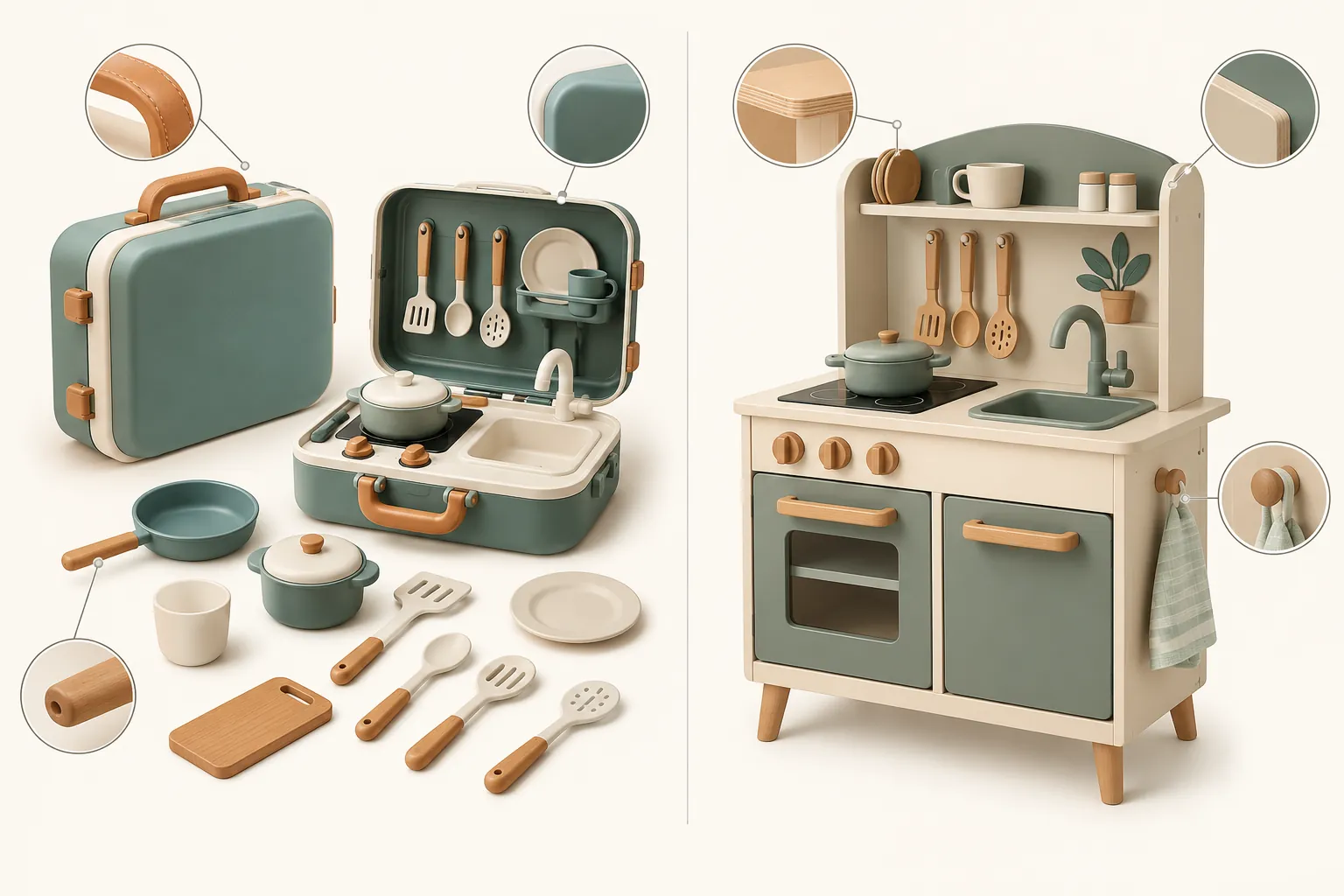
What Do the Listed Carton Specifications Show?
| Suitcase kitchen | Listed outer carton: 85 × 77 × 32 cm; 12 sets/carton; 0.209 m³/carton; gross/net weight: 17/16 kg per carton. Calculated allocation per set: approximately 0.01742 m³; gross/net weight: 1.417/1.333 kg. |
|---|---|
| Villa with light | Listed packaging: color box. Outer carton: 56.8 × 56 × 78 cm; 8 sets/carton; 0.248 m³/carton; gross/net weight: 27.8/24.8 kg per carton. Calculated allocation per set: 0.03100 m³; gross/net weight: 3.475/3.100 kg. Request confirmation of the standing-kitchen configuration before treating it as a format alternative. |
| Full injection molding villa | Listed packaging: color box. Outer carton: 46.5 × 40.5 × 62 cm; 6 sets/carton; 0.117 m³/carton; gross/net weight: 18/16 kg per carton. Calculated allocation per set: 0.01950 m³; gross/net weight: 3.000/2.667 kg. Require a product photograph and description identifying the kitchen configuration. |
Which Packed-Volume Comparison Should Drive the Decision?
Use carton volume divided by sets per carton to compare the shipping-space allocation of each complete set.
The suitcase kitchen calculation is 0.209 ÷ 12 = approximately 0.01742 m³ per set. The full injection molding villa calculation is 0.117 ÷ 6 = 0.01950 m³ per set. Its smaller carton therefore does not mean less carton volume per set. The Villa with light allocates 0.248 ÷ 8 = 0.03100 m³ per set.
For a space-constrained order, use the suitcase kitchen as the lower-volume starting candidate in this comparison, then verify its contents and operation against the intended purchase specification. These figures do not establish a general suitcase-versus-standing advantage, equal play value, or a freight-price difference.
Evidence limits: the source is a catalog listing, not a market report or proof of demand. Its listed specifications are not independently measured results. Do not infer included accessories, age grading, or safety compliance from the listing; request a SKU-specific contents list, age-grading evidence, and applicable destination-market compliance documents from the supplier for review.
What Must Be Confirmed About Setup and Included Accessories?
| Delivered configuration | Send photographs of one unopened retail package, all contents immediately after unpacking, and the finished playable kitchen. For a suitcase, show whether the case forms part of the kitchen or only stores it. For a standing model, confirm whether it arrives fully assembled, partly assembled, or flat-packed, and identify every component shipped detached. |
|---|---|
| Setup burden | Provide the instructions and demonstrate every step from sealed package to playable configuration. Identify required tools, fasteners, detachable legs or panels, and adult assembly steps. If setup time affects the order, record it during the sample demonstration with the start and finish conditions stated. |
| Included accessories | Provide a photographed contents list with the name and quantity of every included piece. Separate kitchen structure, assembly hardware, cookware, utensils, pretend food, and decorative parts so that one total piece count does not disguise different contents. Compare the lists across the candidate SKUs to identify differences in accessory type and quantity. |
| Light or other powered functions | For any powered function offered in the quote, identify the power source, whether batteries are included, and any installation needed before use. Demonstrate the quoted function on the sample. |
| Pack-away and retail-package size | Measure one sealed retail package. Demonstrate whether all included accessories fit inside the suitcase after use and whether any components must be removed. For the standing option, show any disassembly required for storage. |
| Approval record | Identify the supplier item reference, quote revision, sample ID, and contents-list revision. Record the specified target beside the observed result for volume, setup, and contents. Track each supplier question as unanswered, answered awaiting sample check, or verified against the sample, with a response date and evidence reference. Enter approve, approve with conditions, or hold; name the responsible approver and date; assign an owner and closure evidence for each condition. |
When Should You Approve Each Format?
Approve the suitcase format when the sample demonstrates the required carry-and-store arrangement with the agreed accessories; approve the standing format when the assembled sample provides the required freestanding configuration and its setup work is acceptable.
Keep the packed-volume comparison separate from that functional decision. A smaller allocation of carton space cannot compensate for omitted cookware, an unsuitable play configuration, or assembly work outside the agreed specification. Conversely, a larger packed set can remain the right purchase when its demonstrated configuration is the requirement.
Packed-Format Comparison Questions
Does calculated carton volume per set equal the retail-box volume?
No. It allocates the outer carton’s volume across its contents, including each set’s share of shipping space and outer packaging. Use measured retail-package dimensions for shelf planning or individual-parcel calculations.
Does “complete set” mean both formats include the same accessories?
No. Define completeness against an agreed, itemized contents list for each product. Compare the actual cookware, utensils, pretend food, and other included pieces—not just a headline piece count.