
Shortlist non-RC toys by exact version and packing format, then approve mixed-carton specifications separately from the product selection. For toy sourcing in China, use London Toy Fair 2027 registration as a meeting-preparation deadline—not a sales forecast. Record the requested quantity for each item, distinguish proposed packing from final sealed-carton measurements, and reconcile dimensions, CBM, counts, weights, carton strength and shipping marks before accepting the final packing list.
The practical outcome is a shortlist linked to a carton-level decision record: what was specified, what was observed, which differences are acceptable, and who must close any remaining conditions.
What does London Toy Fair 2027 registration establish for sourcing preparation?
Registration establishes an opportunity to prepare trade meetings for January 19–21, 2027, at Olympia, London; it does not establish demand, orders or product availability. The organizer announces that visitor registration is open and describes the event as trade-only. Register through the event website if attending, and use the dates to organize your shortlist and packing questions. Toy Fair
The organizer lists construction and building sets, plush toys and technology toys among its categories. That list is meeting context, not a recommended purchasing mix or confirmation that a particular supplier will offer your selected items. Keep this brief within bubble toys; water and beach toys; non-RC vehicles and tracks; building and science toys; puzzles and learning; and pretend play and dolls. Exclude RC, baby/toddler, sensory/stress-relief and sports toys. Toy Fair
Craft Focus reports that an improved app is scheduled to launch in November, with show information, interactive floor plans and advance meeting scheduling for registered attendees. Use those features when available to attach item-specific questions to meeting requests. A request is not a confirmed appointment, and this brief makes no attendance claim for any supplier. Craft Focus
Which shortlisted items need different packing questions?
| Animal water-spray toy | Recorded fields: ABS material, OPP-bag packing and 240 units per carton. Shortlist decision: retain as a water-and-beach candidate. Ask the supplier to identify the exact animal/version and assortment, confirm the current bag configuration, and propose partitions or other protection if it will share a carton with boxed items. |
|---|---|
| Diecast parking playset | Recorded fields: plastic and metal, color-box packing and 96 units per carton. The listed size is 22.6 × 4.8 × 19.5 cm; confirm what that measurement describes rather than treating it as a master-carton dimension. Shortlist decision: retain as a non-RC vehicle-and-track candidate, subject to version and packing confirmation. |
| Mixed-carton decision | Request a new packing proposal showing each item/version, units of each item, internal arrangement, protective materials and proposed outer-carton measurements. Do not combine or average the two catalog carton quantities to derive a mixed-carton capacity. |
What should the buyer specify before the purchase order?
Before the purchase order, issue a revision-controlled packing proposal that identifies each item, its requested quantity and the exact proposed carton configuration.
Before supplier contact, give each candidate a clear description, exact SKU or supplier item reference, version, assortment and retail-pack revision. Add fields for catalog-recorded material, packing format, units per carton, reference MOQ, size, weight and reference price where present, with currency and unit basis. Retain the source units and identify whether size and weight describe the item, retail pack or master carton; if that basis is unclear, flag it for confirmation. Mark absent fields as “not recorded,” not zero. Keep these catalog entries separate from supplier-confirmed values, with the source or confirmation date beside each.
For YT272676 and YT350175, keep separate candidate records pending matching catalog entries that establish each product’s description, mechanism and version-specific fields. Do not assign either SKU the specifications of the water-spray toy or parking playset discussed above. Hold the shortlist decision open until identity and in-scope category fit are established.
Record the requested order quantity by item alongside its reference MOQ and recorded units per carton, then add the supplier’s proposed quantity of each item in each mixed-carton configuration and the proposed number of cartons. Reconfirm current minimums and order multiples separately: a minimum is not automatically an order multiple, and a catalog carton quantity does not automatically require full-carton ordering.
Ask directly for each item/version: “Please confirm the exact mechanism, material, assortment, current sample and quote, including currency, unit basis and validity; provide evidence supporting the proposed age labeling and the documents required for our destination; and identify any customization options, minimums and lead times. Show the proposed quantity of each item in every mixed carton; identify the retail packing, protection, carton construction, closure and shipping-mark artwork; and provide estimated outer dimensions in centimeters and gross/net weights in kilograms.” If partial cartons or substitutions are proposed, require them to be identified rather than absorbed into an average.
Label these measurements as proposed pre-order packing data. After production and packing, require a final record based on the sealed cartons, with a revised packing list wherever the accepted configuration changes. Revision references help trace changes; they do not guarantee that the contents match the specification.
Keep product-safety release separate. Request evidence appropriate to the exact selected construction and destination, including support for the proposed age labeling, and keep destination-specific document sets separate. Catalog records do not verify certification, licensing, current stock or factory capacity; obtain item-specific confirmation before relying on those claims. Carton measurements, visual inspection and a buyer’s hand check do not certify product safety or determine age suitability.
How should the closed shipping carton be inspected?
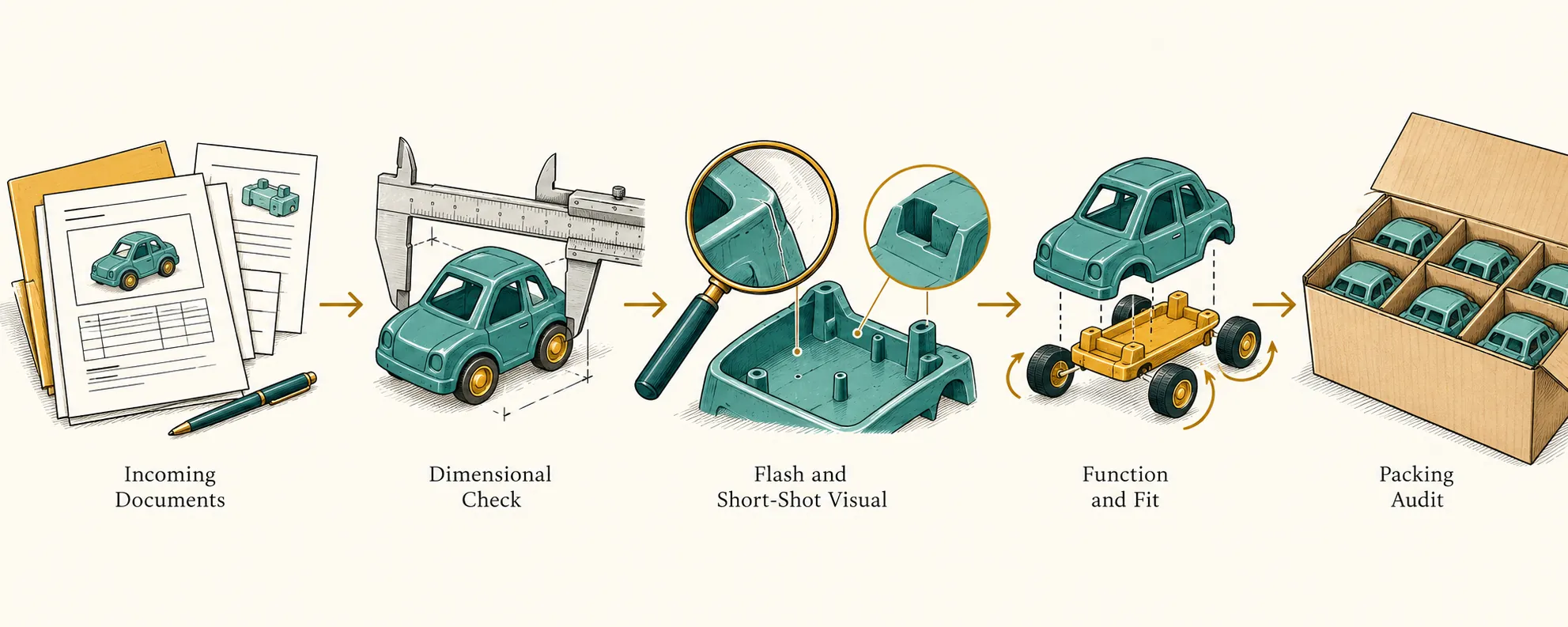
| 1. Identity and packing revision | Inspect: carton identifier, item/version references and packing revision. Compare with: approved packing specification and carton map. Discrepancy: a mixed assortment, substitution or revision that cannot be matched to the approved record. Next decision: identify the affected cartons and resolve the mapping before continuing approval. |
|---|---|
| 2. External dimensions and units | Inspect: final sealed-carton length, width and height in centimeters, including bulging or protrusions; use the agreed orientation consistently. Compare with: the proposed dimensions and buyer-agreed tolerances. Discrepancy: an out-of-tolerance measurement or a unit mismatch. Next decision: remeasure, check the packing arrangement and either correct the pack or approve revised dimensions and CBM. |
| 3. Carton count and item quantities | Inspect: physical number of closed cartons, carton-number sequence and declared quantities of each item. Compare with: purchase-order quantities, carton-level packing records and final packing list. Discrepancy: missing or duplicated carton numbers, unmatched totals or an unexplained assortment change. Next decision: recount and reconcile; where internal quantities remain unresolved, arrange a controlled opening, count, resealing and updated record. |
| 4. Gross and net weights | Inspect: gross weight of the sealed carton in kilograms using a checked scale. Compare with: the approved packing estimate and final packing list. Confirm the declared net-weight definition and its supporting packing or tare record; net weight is not directly observable through a closed carton. Discrepancy: an unexplained difference beyond the agreed tolerance. Next decision: reweigh, verify tare and quantities, then correct the packing or documentation. |
| 5. Carton construction, condition and closure | Inspect: specified board construction, seams, tape or straps, corners, moisture damage, crushing and bulging. Compare with: the approved carton specification and agreed packaging-performance evidence. Discrepancy: substituted construction, split seams, collapsed corners or an insecure closure. Next decision: isolate affected cartons for review, repack or reinforce as approved, and obtain an agreed performance check where required. Appearance alone does not establish compression or transit strength. |
| 6. Shipping marks and labels | Inspect: legibility, carton identifier, item/assortment description, quantity, carton sequence and any dimensions or weights printed on the carton. Compare with: approved shipping-mark artwork, routing instructions and final packing list. Discrepancy: obsolete artwork, conflicting quantities, unreadable marks or incorrect routing information. Next decision: correct the labels and recheck their agreement with the physical carton and final records. |
How is CBM calculated for a mixed-carton shipment?
Calculate CBM from the final external dimensions of each sealed-carton configuration, then multiply by the number of cartons with that configuration.
Explicitly hypothetical example: twelve sealed cartons each measure 60 cm × 40 cm × 35 cm. Per-carton CBM = L(cm) × W(cm) × H(cm) / 1,000,000 = 60 × 40 × 35 / 1,000,000 = 0.084 m³. Total CBM = 0.084 × 12 cartons = 1.008 m³.
Those figures are an illustration, not specifications for either catalog example. If the shipment has different carton sizes, calculate each size group separately and add the subtotals. Do not apply one item’s catalog dimensions to a mixed assortment, use retail-box measurements as master-carton dimensions, or retain estimated CBM after accepting a different final carton size.
What should a completed carton decision record contain?
| Identity and revision | Illustrative record MC-01, packing revision B, reviewed October 27, 2026. Scope: twelve mixed cartons containing the two approved non-RC item versions, with the item-by-item quantities attached to revision B. |
|---|---|
| Specified target versus observation | Target: 60 × 40 × 35 cm sealed outer dimensions. Observation: 60 × 40 × 35 cm; calculated total 1.008 m³ for twelve cartons. Carton count and item totals reconcile with the packing records. Recorded gross weights are within the buyer-agreed limits; net-weight declarations reconcile with the defined packing/tare record. Carton construction matches the approved specification, with no visible closure damage. |
| Discrepancy | Target: shipping-mark artwork revision B. Observation: cartons carry revision A, showing an obsolete assortment description. |
| Decision and responsible approver | Illustrative procurement-manager decision dated October 27, 2026: accept the recorded dimensions, count, weight and condition checks; hold carton-document approval until the shipping marks match revision B. Product-safety and destination-document releases remain separate decisions. |
| Follow-up owner and closure | Supplier packing supervisor to replace the obsolete marks and return carton-numbered photographs for all twelve cartons. Buyer logistics lead to reconcile the corrected marks with the final packing list and record the closure date. Status at review: open; no closure claimed. |
What should be ready for January 19–21, 2027 meetings?
Bring a version-specific shortlist and a packing worksheet that makes every supplier question actionable, rather than a forecast based on the show announcement.
For each candidate, carry the catalog-recorded material and packing format, requested quantity, proposed mixed-carton arrangement, current confirmation questions and shortlist decision. For these two examples, the immediate questions are whether the bagged water-spray version and boxed parking-set version are correctly identified, whether mixed packing is offered, and what configuration the supplier proposes.
Keep meeting status explicit: requested, confirmed or completed. After discussion, record the supplier’s response, revised specification, responsible buyer and review date. Advance a packing proposal only when its quantities and configuration are agreed; accept final carton records only after the sealed measurements, counts, weights and marks reconcile. Registration supplies the calendar anchor—not evidence of an order.