
Approve a wholesale magnetic construction toy order only after the ordered configuration is reconciled with finished-product magnet evidence, draft warnings and a destination-specific documentation plan. For magnetic construction sets purchased wholesale for the US or EU, keep those three streams separate: a magnet specification does not establish enclosure performance, warning artwork does not establish test coverage, and a report naming one standard does not resolve another market’s obligations. Hold unresolved safety or product-identity mismatches before committing.
Before the purchase order, review controlled specifications, supporting reports and draft packaging. Final production dates, lot markings and shipment quantities belong to later release checks—not to a packing list demanded before an order exists.
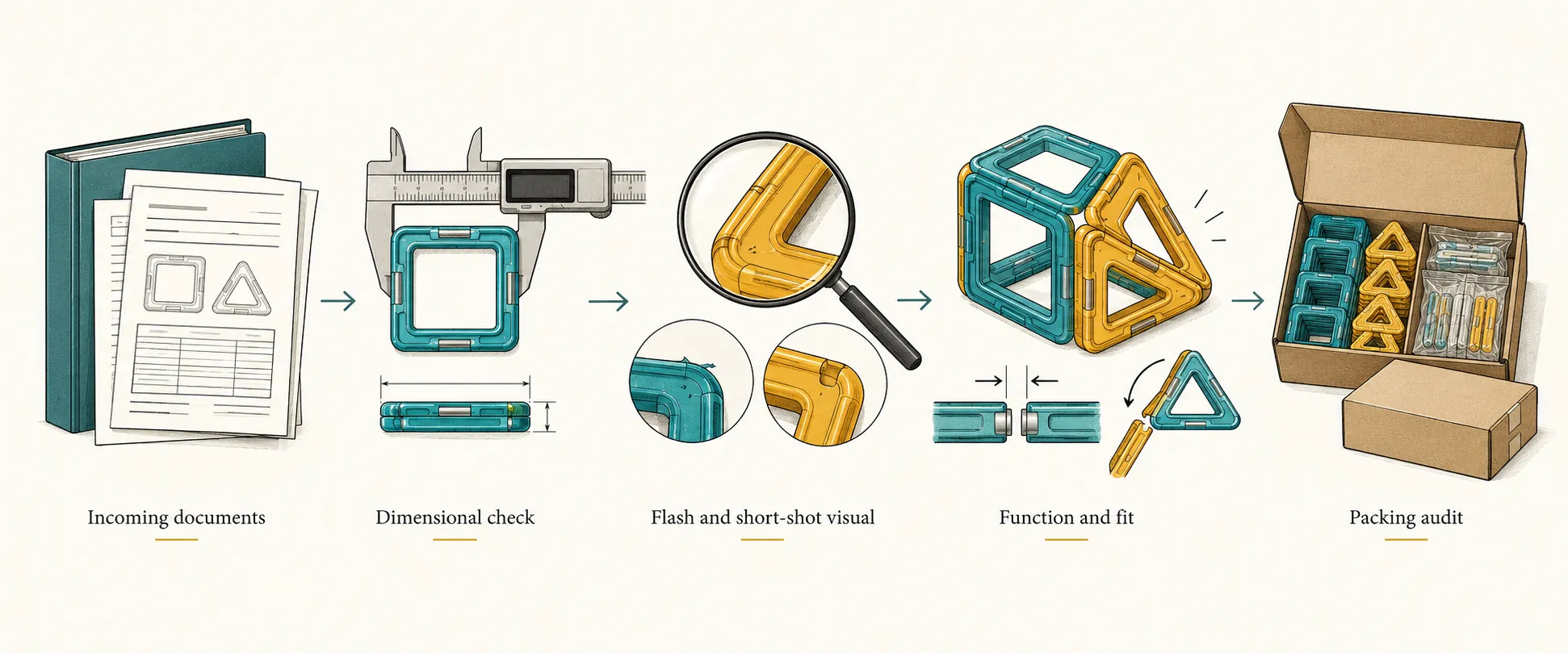
Which documents should the pre-PO approval matrix reconcile?
| Magnet containment evidence | Owner: supplier engineering supplies the controlled specification; the issuing laboratory owns its report; buyer quality/compliance reviews coverage. Specified target: magnet identity, dimensions, count and location per component; enclosure and retention construction; finished-set contents. Observation: transcribe the corresponding report/sample details and results, including condition before and after applicable testing. Reference: BOM/drawing revision, sample photographs, report number, date and relevant pages. Status: select Verified / Missing / To confirm. Mismatch consequence: hold the affected configuration while construction equivalence or additional assessment is resolved. |
|---|---|
| Warnings, age grade and draft packaging | Owner: supplier provides draft artwork and instructions; buyer packaging/compliance approves the destination version. Specified target: intended age and play pattern, included pieces and accessories, exact warning text, languages, placement and identification markings. Observation: compare the actual wording and contents shown on every artwork and instruction revision with the approved specification and supporting assessment. Reference: artwork file/revision, instruction revision and age-assessment reference. Status: select Verified / Missing / To confirm. Mismatch consequence: correct the artwork or reassess the configuration before approving printing. |
| Destination-specific documentation | Owner: the responsible importer or economic operator confirms the applicable route; supplier provides supporting technical records. Specified target: destination, product classification, applicable rules and standard editions, certificate/declaration responsibility, identification and labeling requirements, plus retailer policies recorded separately. Observation: record the confirmed scope and cross-reference the supporting reports and draft certificate/declaration details. Reference: dated applicability assessment and named supporting documents. Status: select Verified / Missing / To confirm. Mismatch consequence: hold commitment for the unresolved destination rather than borrowing another market’s approval. |
What must magnet containment evidence show for the ordered construction?
Magnet containment evidence should identify the finished construction tested and show how the reported assessment addresses magnets becoming accessible or separating from that construction.
Request the controlled bill of materials and drawings alongside the full report. A magnet specification identifies a component; a finished-product report addresses the assembled toy under its stated methods. Procurement guidance specifically recommends retention and use-and-abuse evidence for the finished product rather than a generic magnet certificate. Magnetic STEM procurement
Reconcile field by field: supplier model to report model; ordered revision to tested sample; magnet count and locations to the component layout; shell material, joint and retention method to the tested construction; and package contents to the tested set. For tiles, inspect the documented perimeter enclosure and joint. For blocks or rods, identify the relevant cavities, end closures and any separately supplied magnetic components. Do not infer internal construction from an exterior photograph.
Where the report does not describe an important construction detail, request a documented link from the tested sample to the controlled specification. A similar appearance is not enough: model, photographs, materials, components and age suitability should be checked against the reports. Watchdog Compliance
Use pre-shipment inspection to compare sampled production with the approved construction, markings and package contents. Do not treat a visual check or a buyer’s pull check as magnetic-flux measurement, a substitute for applicable laboratory testing or a guarantee of legal compliance.
What does a public recall illustrate about the documentation check?
CPSC recall 26-291 illustrates why buyers should ask about loose or accessible magnets rather than accept a general magnet-safety statement.
On February 26, 2026, CPSC recalled Grtard Magnet Stick Figure Men Toy Sets, stating that the sets contained loose magnets posing an ingestion hazard. This is a historical US recall of the named product, not a finding about another supplier or construction set. CPSC recall 26-291
The transferable purchasing question is narrow: does the evidence address magnet accessibility and separation for the exact construction being ordered? The recall does not establish that the recalled product lacked documentation, or that completing a worksheet would have prevented the hazard.
How should warnings and age-grade text match the tested set?
Approve warnings and age-grade text as controlled parts of the purchase specification, matched to the actual set and reviewed for its destination.
Request editable draft packaging and instructions before printing approval. Record the exact warning text, language, location, intended age, illustrated play pattern and contents list. Check optional magnetic accessories explicitly: adding an accessory changes what must be reconciled, but does not automatically invalidate every existing report.
Keep age assessment separate from label selection. Ask the responsible reviewer to explain the basis for the intended age and classification; do not treat a “3+” sticker, listing category or “not a toy” statement as the assessment itself. Likewise, “safe magnets” and “non-toxic” are marketing statements, not laboratory results.
If the artwork depicts a different set, omits an included magnetic component or uses an age grade inconsistent with the assessment, return it for correction or reassessment. Printing a warning is not a substitute for resolving a construction concern.
Which documentation questions should US and EU buyers ask separately?
US and EU buyers should obtain separate, destination-specific applicability reviews rather than treat ASTM F963, EN 71 or a generic certificate as interchangeable approvals.
For a US order, ask the US importer or compliance reviewer to identify the applicable CPSC rules and standard editions, whether a Children’s Product Certificate and CPSC-accepted laboratory testing apply, who will issue the certificate, and which product and packaging markings must be approved. Record the rationale for the selected product classification and testing route.
For an EU order, ask the responsible economic operator to identify the applicable toy legislation, conformity-assessment route, relevant EN 71 parts and editions, declaration-of-conformity responsibility, technical documentation, markings and required language versions. Have the reviewer identify any additional general product-safety obligations relevant to that configuration and sales channel.
These are purchasing requests, not a universal legal document list. Record the legal basis and applicability date in the destination assessment, and keep retailer or marketplace document-age policies separate from statutory requirements. For another destination, commission its own assessment rather than extending either the US or EU file by assumption.
Which records belong before the PO and which belong before shipment?
Before the PO, approve the product definition and documentation responsibilities; before shipment, reconcile the actual production and shipment records with that approval.
The pre-PO file should contain the controlled specification, dated sample identity, supporting evidence or a defined testing plan, draft artwork and instructions, and the destination assessment. If final testing remains outstanding, document that fact as a commitment condition rather than recording the configuration as verified.
After production details are established, complete the relevant certificate or declaration data at the appropriate stage, verify final artwork and production markings, review inspection and corrective-action closure, and reconcile the commercial invoice and final packing list with the actual shipment.
Do not require a final packing list before the order exists. Do require a named owner and release gate for each later document.
What written request can a buyer send before committing?
Send a configuration-specific request that identifies the documents to reconcile and the decision each document supports.
“Please identify the supplier model, revision and dated sample for our proposed magnetic construction set, and provide the controlled BOM/drawings showing magnet identity, count, locations and retention construction.
Please provide the full finished-product reports and sample photographs, with references showing how their scope covers this configuration. Identify any differences between the tested sample and the proposed order.
Please send draft packaging and instructions showing the age grade, exact warnings, languages, contents and identification-marking locations. Identify the owner and timing for the destination-specific assessment and certificate/declaration documents.
Please list outstanding actions with responsible persons and due dates, distinguishing pre-PO approvals from production and shipment-release records.”
Record the buyer’s decision as Approve, Conditional commitment or Hold, with approver name, date, conditions and closure references. Use conditional commitment only where the unresolved scope and commercial exposure are deliberately bounded; do not use it to accept an unresolved safety concern or bypass an applicable obligation. A signed record supports traceability, but cannot reveal an undisclosed substitution by itself.
What report-coverage questions remain before approval?
Does every later batch or different internal SKU need a new report?
Do not assume so. Compare the construction and report scope, review design, material and process changes, and separately check applicable retesting duties and buyer or retailer policies. A different internal item number is not, by itself, evidence of a different construction. Product changes warrant reassessing whether existing testing still supports supply.
Does a test report universally expire after twelve months?
Do not apply a universal twelve-month cutoff. Check the applicable rules, the tested construction, subsequent changes and the specific retailer or marketplace policy. Record any commercial freshness requirement separately from the basis for accepting the technical evidence.
Can one report cover multiple pack sizes or variants?
Accept shared coverage only when its documented scope supports the ordered variants. Map each pack’s components, magnet construction, materials and accessories to the tested samples and any documented coverage rationale; do not infer coverage merely because the packaging looks similar.