An importer with a 14-SKU private label toys program — 4 bubble toys, 3 beach sets, 3 die-cast-style vehicle packs, 2 puzzle assortments, 2 pretend-play sets — faces a routing question before a single purchase order is issued: does the whole program ship as one consolidated mixed carton from Yiwu, or do the plastic-heavy and tooling-heavy SKUs move to a specialized Chenghai producer? The U.S. market context makes the stakes concrete: s toy dollar sales up +20% from January through September 2026, units up +18%, and average selling price up +2%, with squishy toys alone generating quotation on request million in that window.
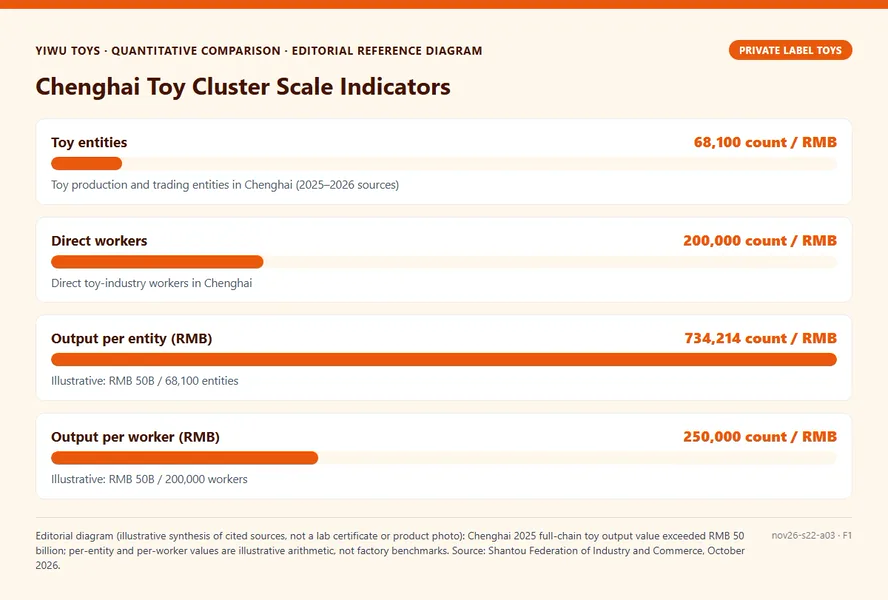
This is a decision matrix, not a verdict. Yiwu-style consolidation solves breadth and small-lot mixing across the six categories Yiwu Toys publishes — Bubble Toys, Water & Beach Toys, Toy Vehicles & Tracks, Building & Science Toys, Puzzles & Learning, and Pretend Play & Dolls. Chenghai specialization solves depth: more than half of China's plastic toys and about one-third of the world's plastic toys come from a district with roughly 68,100 toy production and trading entities and about 200,000 direct workers. The correct answer is usually a split, and the split is decided SKU by SKU against tooling, electronics, carton structure and U.S. compliance documentation.
What Chenghai Specialization Actually Delivers — and What It Does Not
Chenghai's pitch is supply-chain closure, not catalog breadth. Regional sources describe nearly 100% of toy parts purchasable locally, new products moving from design to mass production in as fast as 7 days, and a working rhythm of 24-hour supporting, 3-day sampling and 1-week shipping. Those are ecosystem claims about the district, not guarantees from any one factory, and they matter most when a private-label SKU needs new tooling, a revised mold, or an electromechanical assembly that cannot be assembled from stock components.
The scale figures are large but unevenly distributed. Chenghai's 2025 full-chain toy output value exceeded RMB 50 billion across roughly 68,100 production and trading entities. A simple illustrative planning calculation — RMB 50,000,000,000 divided by 68,100 entities — yields about RMB 734,214 of output value per entity, and divided by 200,000 direct workers yields RMB 250,000 per worker. That arithmetic is not a factory benchmark; it is a warning that the average entity in a 68,100-entity cluster is modest in size, so cluster scale does not substitute for factory-level verification of tooling ownership, sample approval and production scheduling.
Depth shows up in specific sub-categories. Chenghai accounts for about 50% of China's building-block capacity and about one-third of global building-block capacity, and its toy enterprises rank first nationally in both IP authorization count and brand ownership count. For a private-label building set or a licensed-style pretend-play line, that concentration shortens the path from concept to mold to carton. For a 600-unit bubble-toy refill run, it adds tooling cost and minimum-run friction that a mixed-market consolidation route avoids.
What Yiwu-Style Consolidation Is Actually Good For
Cross-category consolidation wins on order structure, not on manufacturing depth. A buyer assembling 8 to 14 SKUs across bubble toys, water and beach toys, non-RC vehicles, puzzles and pretend play needs one shipment, one set of carton marks and one document pack per destination — not five separate factory relationships with five sampling calendars. Yiwu Toys frames its catalog around exactly that job: turning a category brief and a product shortlist into comparable supplier questions and order specifications, with quantities, customization, lead times and documentation confirmed per item and destination.
The consolidation route carries a specific documentation burden that buyers underestimate. When one carton holds SKUs from different producers, the private-labeler identity on the tracking label, the batch or run number per SKU, and the country-of-origin mark must be resolved at the carton level, not the factory level. CPSC tracking-label guidance requires the manufacturer/importer or private labeler name, location and date of production, batch or run information, and other source-identifying details to be ascertainable from permanent marks on the product and its packaging to the extent practicable. A mixed carton with four producers and one private-label brand needs four batch codes and one clearly named private labeler.
Consolidation also absorbs demand volatility that specialization cannot. January–September 2026 U.S. data shows +18% unit growth alongside +2% average selling price growth, meaning volume, not price, drove the year. For an importer testing a new bubble-toy or beach-set design at 500 to 1,500 units per SKU, a mixed-market route keeps the test cheap; a dedicated mold in a specialized cluster does not.
Decision Matrix: Yiwu Consolidation vs Chenghai Specialization
Read each row against the specific SKU, not the whole program. A single private-label program can legitimately occupy both columns: 9 consolidation SKUs and 5 specialization SKUs in one season.
| Buyer test | Decision factor | Yiwu consolidation route | Chenghai specialization route |
|---|---|---|---|
| Does the SKU need fewer than 1,500 units to validate demand? | Typical order structure | Small-lot mixed orders across 6 published categories; quantities confirmed per item and destination | Larger single-category runs tied to mold and assembly setup in a 68,100-entity cluster |
| Does the SKU sit in a sub-category where Chenghai holds measurable share? | Category breadth | Bubble toys, water and beach toys, vehicles and tracks, building and science, puzzles and learning, pretend play and dolls | Plastic-heavy and building-block lines; about 50% of China's building-block capacity sits in Chenghai |
| Does the SKU require a new mold or an electromechanical assembly? | Tooling and electronics | Stock or lightly customized components; new mold ownership confirmed per item | New molds, local parts sourcing near 100%, design-to-mass-production as fast as 7 days at ecosystem level |
| Does the launch calendar tolerate one consolidated sample round or require 3-day iteration? | Sampling and iteration speed | Sample rounds scheduled per SKU across multiple producers in one program | Regional rhythm described as 24-hour supporting, 3-day sampling, 1-week shipping |
| Can the route produce a CPC citing every applicable children's product safety rule for each SKU? | U.S. compliance documentation | CPC and English test reports per SKU; one named private labeler across mixed cartons | CPC and English test reports per SKU; batch codes tied to a single production run |
| How many producers share one carton, and who applies each batch code? | Carton and packing complexity | Multi-SKU cartons; carton-level marks, batch codes and origin marks resolved per SKU | Single-SKU or few-SKU cartons; simpler batch-code logic per run |
The U.S. Compliance Overlay That Decides the Route
Compliance documentation is the tie-breaker in most split decisions. U.S. CBP requires every article of foreign origin entering the United States to be legibly marked with the English name of the country of origin unless an exception applies. CPSC requires children's products subject to a children's product safety rule to be third-party tested by a CPSC-accepted laboratory and covered by a written Children's Product Certificate, with the CPC and supporting test reports in English. A private-label program that cannot produce a per-SKU CPC and English test report fails at the port regardless of which cluster produced it.
Port enforcement is not theoretical. CPSC and CBP stopped more than 8 million units of about 4,500 different types of toys and children's products over four years for safety hazards or failure to meet federal standards, including lead, small parts, sharp points and labeling violations; an earlier five-year window saw more than 9.8 million units of about 3,000 toy types stopped. For a mixed carton, that record translates into one rule: every SKU in the carton needs its own document set, and the carton needs a named private labeler who can be contacted to interpret any code on the tracking label.
Tariff exposure adds a commercial layer to the routing decision. A Toy Association survey of more than 400 member companies found nearly half of small and medium-sized enterprises stating they may soon go out of business under the then-current U.S. tariff policy on toy imports from China. That pressure favors consolidation for test SKUs — one shipment, one entry, one document pack — and favors specialization only where tooling or electronics make the SKU unbuildable in a mixed-market route.
The Four-Field Split Test Before Any PO
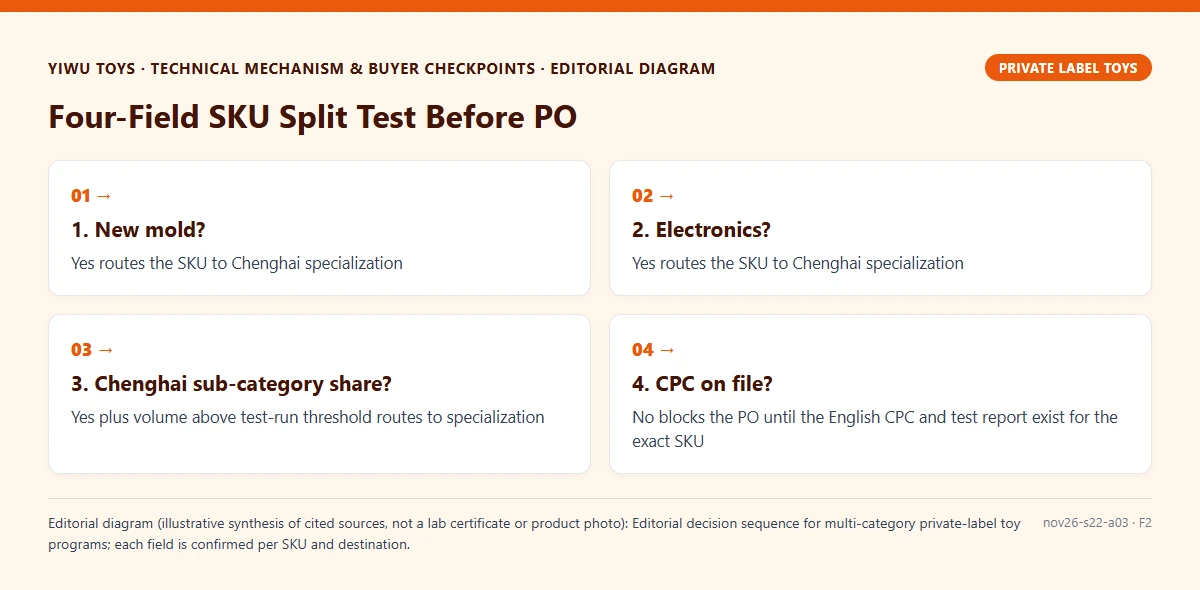
Classify each SKU with four binary fields and the split ratio falls out arithmetically. Field 1 — new mold required: yes or no. Field 2 — electromechanical assembly: yes or no. Field 3 — sub-category where Chenghai holds measurable share, such as building blocks at about 50% of China's capacity: yes or no. Field 4 — CPC and English test report already on file for the exact SKU: yes or no. A SKU scoring yes on Field 1 or Field 2 routes to specialization; a SKU scoring no on all four routes to consolidation; a SKU scoring yes only on Field 3 routes to specialization when volume exceeds the test-run threshold.
Apply the test to the 14-SKU example: 4 bubble toys and 3 beach sets score no on all four fields and consolidate; 3 vehicle packs with new molds and 2 building sets in Chenghai's strongest sub-category route to specialization; 2 puzzle assortments consolidate unless a new die-cut is required. The result is a 9/5 split, two document packs, and one clear private-labeler identity per carton.
A Split-Program Workflow for Multi-Category Importers
Step 1 — build the SKU register before sampling. List every SKU with its category, target units, mold status, electronics status and destination country. The register is the only document that lets a buyer compare a Yiwu consolidation quote against a Chenghai specialization quote on the same basis, because the two routes price different things: mixed-carton assembly versus mold and run setup.
Step 2 — lock the compliance fields per SKU, not per supplier. For U.S.-bound children's products, the register must carry the country-of-origin mark text, the CPC citation list, the English test report reference, the private labeler name and address, and the batch-code format. CPSC tracking-label guidance allows codes as long as the consumer knows who to contact to interpret them, so the private labeler's contact path belongs in the register, not in a side email.
Step 3 — set the carton logic. A consolidation carton holding 4 producers needs 4 batch codes, 4 sets of origin marks and one carton-level packing list that maps each code to its SKU. A specialization carton holding one run needs one batch code and one origin mark. The carton logic, not the factory name, determines how many document packs the shipment carries.
Step 4 — schedule sampling against the launch calendar. Chenghai's ecosystem rhythm of 3-day sampling and 1-week shipping supports a fast iteration loop for a new mold; a consolidated program across 9 SKUs needs a sample calendar that sequences 9 approvals without collapsing into one rushed round. Guangdong's 2025 toy export value of RMB 89.7 billion and above-scale toy revenue of RMB 79.5 billion describe a province-scale supply base, not a per-order schedule — each SKU still carries its own sample date.
Step 5 — verify at the factory level inside the cluster. Chenghai's 68,100 entities and 295 above-scale toy enterprises in Shantou mean the cluster contains both large exporters and small workshops. The RMB 734,214 average output per entity is an arithmetic average, not a capability rating; tooling ownership, CPC coverage and carton control are confirmed factory by factory, SKU by SKU.
Should a cross-category importer always consolidate private label toys in Yiwu?
No. Consolidation fits small-lot mixed orders across the six published categories, while plastic-heavy or electromechanical SKUs belong in a specialized cluster such as Chenghai, where about one-third of the world's plastic toys are produced. The split is decided SKU by SKU against mold status, electronics, sub-category share and CPC coverage.
What U.S. documents must be confirmed before ordering private-label toys from China?
Three document sets are mandatory for U.S.-bound children's products: the English country-of-origin mark required by CBP, the Children's Product Certificate with English third-party test reports from a CPSC-accepted laboratory, and the tracking-label fields covering private labeler name, production location and date, and batch or run number. Each set is confirmed for the exact SKU and destination, not for the supplier in general.
Does Chenghai's scale mean every supplier there is suitable for private label?
No. The district figures — roughly 68,100 toy production and trading entities and RMB 50 billion-plus in 2025 full-chain output — describe an ecosystem, not a factory. The arithmetic average of about RMB 734,214 of output per entity confirms that most entities are modest in size, so mold ownership, CPC coverage, sample approval and carton control are verified factory by factory.
Turn Your Category Brief Into a Comparable SKU Register
Send Yiwu Toys your category brief and product shortlist across bubble toys, water and beach toys, vehicles and tracks, building and science, puzzles and learning, or pretend play and dolls. The output is a structured SKU register with the four split-test fields, carton logic and the per-item document list, so a Yiwu consolidation quote and a Chenghai specialization quote can be compared on identical terms. Quantities, customization, lead times and documentation are confirmed for each item and destination before any purchase order.
Sources
stgsl.shantou.gov.cn — 融媒观察 | 澄海把玩具的门开给世_图片新闻_汕头市工商业联合会(总商会)
stgsl.shantou.gov.cn — 全球七成塑料玩具汕头造!“广货行天下”春季行动玩具专场促销活动在汕启动_图片新闻_汕头市工商业联合会(总商会)
www.cbp.gov — Marking of Country of Origin on U.S. Imports | U.S. Customs and Border Protection