
Move a Yiwu mixed-carton shortlist into order-specification handoff only when each selected version, quantity basis and packing arrangement is identifiable, with unresolved points assigned to a named owner. For Spielwarenmesse 2027 buyer preparation, the practical next document is a revision-controlled packing specification—not another product list. Keep proposed pre-order dimensions separate from final closed-carton measurements, then reconcile counts, weights, strength evidence and shipping marks before approving the packing list. A fair meeting can resolve questions; it cannot substitute for that record.
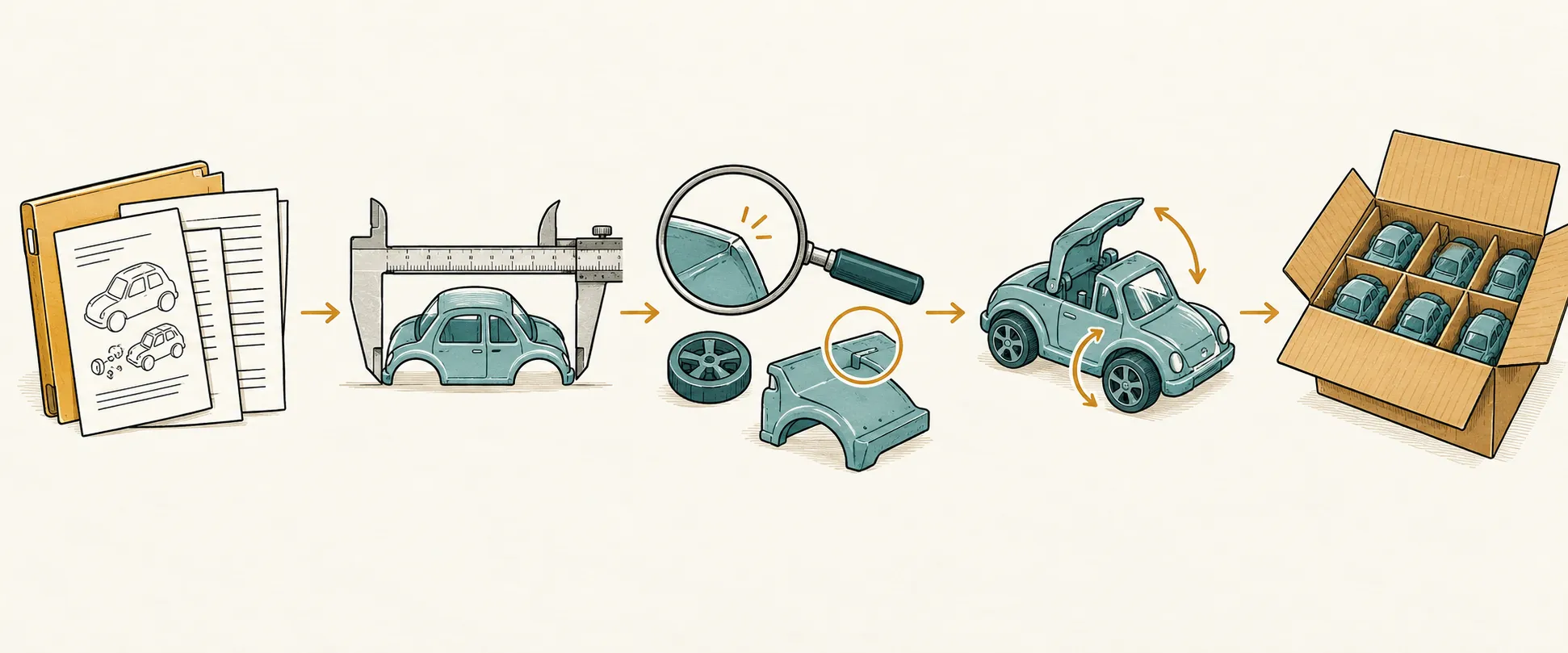
Which shortlisted items are ready to become order lines?
An item is ready to become an order line when the buyer and supplier can identify the same version, selling unit and packing configuration without relying on a photograph alone.
Keep the shortlist within bubble toys; water and beach toys; non-RC vehicles and tracks; building and science toys; puzzles and learning; and pretend play and dolls. Record only the categories actually selected. The carton handoff should follow those items, not expand into a general catalog.
Turn version choices into direct supplier requests. For a shortlisted bubble set, specify whether solution is included and how it is contained within the retail pack. For a non-RC track set, identify the selected layout and included vehicle count. For a puzzle, identify the design, piece count and retail-box revision. These are questions to resolve for the chosen item, not specifications to assume across a category.
State quantities in the purchasing unit: individual toys, complete sets or retail packs. Then identify how those units are allocated to each shipping carton. A catalog carton quantity belongs to that exact item and pack configuration; it neither establishes a mixed-carton allocation nor automatically creates an order multiple.
What belongs in the next document handoff?
| Record identity and revision | Assign a handoff reference, revision, issue date, supplier contact and buyer owner. Link the item schedule, packing specification, carton allocation and shipping-mark artwork by revision. |
|---|---|
| Item identity and selected version | Keep separate item records for YT298380 and YT348771. Record each item's category, exact documented mechanism, selected configuration, included components and retail-pack revision from item-specific evidence; leave unavailable details open rather than inferring them from the SKU. Link the image or specification that distinguishes the selected version from alternatives. |
| Field-level status and evidence | For every specification field, enter its value, status (verified, supplier-confirmed or open), evidence type, source or attachment reference, evidence date and applicable item revision. Identify what was checked and by whom for verified fields. Preserve catalog wording as catalog-recorded evidence without upgrading it to a verified specification. |
| Quantity basis and carton allocation | State the purchasing unit, requested quantity per item, allocation to each carton ID or carton group, and any separately agreed order restrictions. |
| Proposed pre-order packing | Request external carton dimensions with units, estimated gross and net weights, carton construction, internal protection, sealing method and proposed shipping marks. Label estimates as proposed—not final packed observations. |
| Final packed observations | Record closed-carton external dimensions, gross weight, condition and marks against carton IDs. Reconcile item quantities and net weights with packing-stage records and the final packing list. Retain the agreed targets alongside observations so discrepancies remain visible. |
| Supplier questions and confirmation status | Write one answerable request per unresolved field, with its owner, required response and agreed follow-up date. Preserve the written answer or revised attachment, then update that field's status only to the level supported by the response or subsequent verification. |
| Decision and closure | Record approved, conditionally approved or held; identify the responsible approver, applicable item and document revisions, and decision date. For each condition, retain the correction, recheck result, closure owner and closure date. |
How should the closed shipping carton be inspected?
| 1. Carton identity and configuration | Compare the carton ID and pack configuration with the approved allocation sheet. A carton assigned to the wrong configuration is a discrepancy even if its dimensions look correct. Identify and segregate the affected cartons, then correct the allocation or marks before continuing reconciliation. |
|---|---|
| 2. External dimensions and units | Measure the sealed, loaded carton in its shipping condition, including outward bulges, using the agreed length, width and height convention. Compare with the approved dimensional target and tolerance, in the same units. Recheck a difference outside that tolerance; then obtain a packing correction or buyer approval of revised dimensions and volume. |
| 3. Carton count and item quantities | Compare physical carton IDs and total carton count with the carton allocation sheet and final packing list. Reconcile each item’s packed quantity with the approved order quantity and packing-stage count record. A sealed label alone does not verify internal contents. Hold the affected allocation for a count recheck if quantities cannot be reconciled. |
| 4. Gross and net weights | Weigh the closed carton in kilograms and compare its gross weight with the agreed target and packing-list entry. Check net weight against the packing-stage record; do not infer it from gross weight alone. An unexplained difference calls for a scale check and review of contents and packing materials before approval. |
| 5. Carton condition and strength | Compare the specified carton construction, closure and internal support with the packing record and available strength-test evidence. Inspect for crushed corners, split seams, moisture damage and distorted panels. Visible damage calls for correction and reinspection; acceptable appearance alone does not establish compression strength. Where strength testing is agreed, record the method, conditions and acceptance criterion. |
| 6. Shipping marks | Compare visible marks with buyer-approved artwork and the carton allocation: order reference, carton sequence, contents or assortment identifier, and any agreed count, weight or handling information. Wrong, illegible or conflicting marks require correction and a packing-list cross-check. Keep destination-specific paperwork in its own review rather than treating carton-mark approval as approval of all shipment documents. |
How should final carton CBM be calculated?
Calculate carton CBM from final external packed dimensions, and multiply by carton count only when those cartons share the same dimensions.
Explicitly hypothetical example: a proposed closed carton measures 60 cm × 40 cm × 40 cm. CBM = L(cm) × W(cm) × H(cm) / 1,000,000, so 60 × 40 × 40 / 1,000,000 = 0.096 m³ per carton. For 10 identical cartons, the proposed total is 0.096 × 10 = 0.960 m³.
Suppose final measurement shows 61 cm × 40 cm × 40 cm for each of those 10 cartons. The final calculated volume becomes 0.0976 m³ per carton and 0.976 m³ in total. That difference is not automatically a failed shipment. Compare it with the buyer-agreed tolerance, check the measurement and decide whether to correct the packing or approve the revised figures.
For differently sized cartons, calculate each configuration separately and add the results. Do not carry a single-item catalog CBM into a newly assembled mixed carton.
Hypothetical Mixed-Carton Handoff Record
| Identity and revision | Record MIX-01, revision B, issued October 27, 2026; supersedes revision A. Scope: one mixed-carton configuration repeated across cartons C01–C10. |
|---|---|
| Selected items and versions | Item A: puzzles and learning; selected puzzle design and piece-count specification linked to item sheet A, revision 1. Item B: non-RC vehicles and tracks; selected vehicle-set configuration linked to item sheet B, revision 1. Status: supplier-confirmed and buyer-approved for this example. |
| Order quantity and packing allocation | Purchasing unit: complete retail sets. Item A: 60 sets; Item B: 40 sets. Each carton is allocated six Item A sets and four Item B sets. Packing-stage count record and carton allocation reconcile with these quantities. Status: reconciled. |
| Specified target versus observation | Revision A target: 60 × 40 × 40 cm external packed dimensions. Final recorded observation: 61 × 40 × 40 cm for each carton C01–C10. Status: discrepancy reviewed; revised dimensional specification approved in revision B. |
| Volume correction | Proposed total: 0.960 m³. Revised final total: 0.976 m³. Packing-list volume updated to match the final dimensional record. |
| Weight, strength and marks | Gross-weight observations reconciled with the final packing list; net weights reconciled with the packing-stage record. Carton construction and agreed strength-test evidence reviewed against the packing specification. Closed-carton condition and shipping marks accepted against the approved references. |
| Supplier question and follow-up | Request: confirm whether the additional external length is a repeatable packing result or a measurement error. Assigned owner: supplier packing coordinator. Required follow-up: remeasure C01–C10 and submit a revised packing list before final packing-data approval. |
| Decision and closure | Hypothetical outcome: remeasurement confirms 61 cm external length. Responsible approver: buyer packing lead. Approval and closure date: October 27, 2026. Decision: accept revised dimensions and close the packing-data condition against revision B. |
What does Spielwarenmesse 2027 establish for this handoff?
Spielwarenmesse 2027 establishes an event-planning reference, not a deadline for approving a Yiwu mixed-carton order.
The organizer states that the fair takes place February 2–6, 2027, in Nuremberg. Its digital platform offers an interactive hall plan and an exhibitor database filterable by company, product, brand and license. Use those tools to identify contacts and prepare item-specific packing questions; confirm individual meetings separately. The announcement does not establish order deadlines, freight lead times, a particular supplier’s attendance or market access. Spielwarenmesse Group
The same announcement says ticket sales begin in early November and tickets cannot be purchased on site. Arrange advance tickets separately from the purchasing approval process. Spielwarenmesse Group
When should the buyer approve the handoff?
Approve the order-specification handoff when selected versions, quantity units and packing targets are agreed; approve final packing data only after closed-carton observations and the packing list reconcile.
Conditional approval should name exactly what may proceed and what remains blocked. A supplier may answer questions while the scope is being defined, but an unresolved assortment or packing allocation should not become an assumed order commitment.
Keep product-safety release separate from carton approval. Neither a carton measurement nor a buyer’s hand check certifies product safety. The handoff record supports traceability and correction; it does not, by itself, prevent an undisclosed change.