
A seasonal general-merchandise buyer locking a 2027 summer plan in the first quarter faces a category that is shrinking at the top and fragmenting at the bottom. U.S. retail toy sales reached quotation on request billion in 2025, up 6% vs 2024, but Outdoor & Sports Toys fell 6% to quotation on request billion and sat 34% below 2021, data published by The Toy Association. Through September 2026 the split widened: total toy dollars grew 20% and units 18%, while the largest declines concentrated in outdoor, active and seasonal play segments.
That is the frame for water toys wholesale in 2027. You are not buying into a tailwind; you are buying a disciplined, differentiated summer set. The three formats that dominate the shelf — pull-pump blasters, backpack reservoir tanks and hose-fed splash mats — differ less on retail price than on seal count, drying hygiene, carton cube per unit and the paperwork behind zero-battery reliability. This guide converts each format into the fields you write into a purchase order before sample approval.
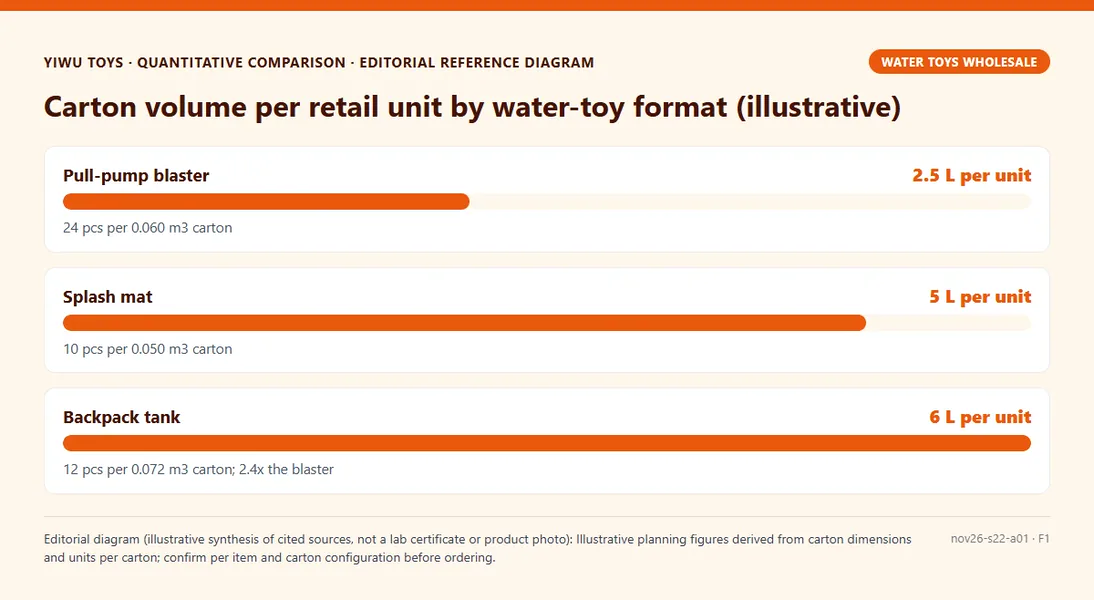
One planning number sets the tone. Using illustrative carton data that must be confirmed per item, a pull-pump blaster at 24 pcs per 0.060 m3 carton occupies 2.5 L per retail unit, a backpack tank at 12 pcs per 0.072 m3 carton occupies 6.0 L, and a splash mat at 10 pcs per 0.050 m3 carton occupies 5.0 L. The backpack tank consumes 2.4x the cube of the blaster per unit. Freight, not FOB, decides which format earns shelf space.
Pull-pump blasters: count the seals before you count the margin
A manual pressure-pull blaster moves water through three interfaces: the pump cylinder seal, the check valve and the nozzle joint. Each is a leak candidate under repeated cycling, and each needs a stated specification rather than a supplier adjective. Write the seal material, the check-valve type (ball, flap or umbrella), the nozzle orifice diameter in millimeters and the pressure ceiling in kPa into the sample approval sheet. A blaster with a 3 mm orifice and a 60 kPa ceiling behaves differently at retail than one with a 5 mm orifice and no stated limit.
The AAP advises avoiding toys that shoot objects into the air because they can cause serious eye injuries or choking, and names gel blasters as linked to serious eye injuries. A water blaster is not a gel blaster, but the design logic overlaps: stream type, pressure and nozzle geometry are safety fields, not marketing fields. Specify a continuous stream rather than a pulsed projectile, cap the pressure, and require the supplier to state the stream distance measured at the stated pressure. Treat 'shoots far' as a risk flag in any quotation.
The blaster's commercial advantage is cube. At 2.5 L per unit in the illustrative calculation, a 40-foot high-cube container at roughly 68 m3 usable volume holds about 27,200 blaster units. A 1,000-unit trial order occupies about 2.5 m3, roughly 3.7% of that container. That is the format that lets you test three colorways and two nozzle sizes in one shipment without paying for air.
Drying is the hidden line item. A blaster with a drain port and a removable nozzle cap air-dries in a retail carton; one without a drain port traps water in the pump chamber and arrives at the DC with condensation. Specify the drain port diameter, the drying interval before packing and the polybag venting. Those three fields decide whether the carton smells of chlorine or mold at receipt.
Backpack reservoir tanks: four extra failure points and a cube penalty
A backpack tank adds four failure points to the blaster architecture: the reservoir seam, the cap thread, the hose coupling and the harness anchors. Each needs a written spec. Reservoir seam: weld type (heat, ultrasonic or solvent) and a stated burst pressure in kPa. Cap thread: thread pitch in millimeters and a cap torque range in N·cm so the cap seals without cross-threading at retail. Hose coupling: inner diameter in millimeters and the coupling standard so replacement hoses fit. Harness anchors: stitch count per anchor and a pull-force value in newtons.
Drying hygiene is the format's weakest point. A reservoir that holds 2 L to 5 L of water and is stored wet grows biofilm within days; the retail consequence is a returned unit with a smell the buyer cannot explain to a category manager. Write a full-drain requirement, a drain-plug diameter, a drying interval before packing and a storage instruction printed on the retail box. Those four fields belong in the order spec, not in a care leaflet added at the last minute.
The cube penalty is measurable. At 6.0 L per unit in the illustrative calculation, the same 68 m3 high-cube container holds about 11,333 backpack tank units — 2.4x fewer than blasters. The retail price must absorb that freight share or the order mix shifts. A practical response is to pair the tank with a flat-packed accessory in the same carton so the cube per retail dollar falls, and to reserve the tank for a higher price tier where the harness and reservoir justify the space.
Age grading matters here. lists water toys among appropriate play materials for older infants aged 7 to 12 months, which means a reservoir tank marketed to a 3+ audience sits in a different compliance and labeling lane than a splash mat sold to a family set. State the age band on the sample approval sheet and hold the supplier to it through carton marking.
Hose-fed splash mats: weld quality, inlet compatibility and fold-flat drying
A hose-fed splash mat concentrates risk at three points: the inlet coupling, the seam welds and any inline valve. The inlet coupling must match the garden-hose standard used in the destination market; a mat that fits a 12.5 mm (1/2 inch) coupling in one market and not another generates returns that look like quality failures but are compatibility failures. Write the coupling inner diameter, the thread type and a compatibility note on the retail box.
Seam welds are the second field. Specify weld width in millimeters, a visual weld inspection at 100% of units and a leak test at a stated inlet pressure in kPa for a sample lot. The AAP's warning against thin plastic that breaks into sharp pieces maps directly to wall thickness: state the film thickness in micrometers for the mat body and the inflatable chambers. A mat that passes a 30-minute fill test but fails a 24-hour standing-water test is a returns problem disguised as a design feature.
Drying is where the format wins and loses. A flat-packed mat folds to a small retail box, but water trapped in the seam channels between uses is a mold risk. Specify a drainage point at the lowest seam, a fold-flat drying instruction and a retail-box ventilation slit. At 5.0 L per unit in the illustrative calculation, the mat sits between the blaster and the tank on cube, which makes it the natural anchor of a beach toys wholesale assortment where the retail box doubles as the carry case.
The low end of the category competes with free household alternatives; play guidance for toddlers 1–2 years uses household items such as boxes and shatter-proof bowls as play materials. That is the price ceiling argument for a splash mat: it must deliver a play pattern a cardboard box cannot, or the retail price collapses toward the household-goods aisle.
Zero-battery reliability: what it removes and what it does not
Zero-battery water toys remove battery, motor and wiring failure modes, and that is a real reliability gain for a seasonal SKU that sits in a warehouse for nine months. It does not remove compliance work. U.S. product safety documentation Section 106 made ASTM F963 a mandatory consumer product safety standard for children's toys, codified at 16 C.F.R. part 1250, with third-party testing and a Children's Product Certificate required for products primarily for children 12 and under. ASTM F963 covers toys intended for children under 14, while CPSC testing and CPC certification apply to products primarily for children 12 and younger.
That distinction sets the paperwork sequence. A blaster, tank or mat aimed at a 6+ audience needs a CPC from a CPSC-accepted laboratory before the PO ships. A product aimed at a 13+ audience falls outside the CPC requirement but still sits inside ASTM F963 scope. The age band on the sample approval sheet is therefore a compliance field, not a marketing field.
Seal and material specs must be tied to testable clauses rather than supplier statements. Write the material grade for the reservoir and mat film, the phthalate and heavy-metal limits the destination market requires, and the small-parts classification for any detachable nozzle, cap or plug. For U.S.-bound goods the small-parts test uses the CPSC small-parts cylinder specified in 16 C.F.R. part 1501; a detachable nozzle cap that fits inside that cylinder changes the age grade and the test plan. EU and UK requirements such as EN 71 are not covered by the U.S. sources here and must be confirmed separately for each destination.
The reliability test plan follows the same logic. Specify a cycle count for the pump or valve (for example 500 fill-and-spray cycles on a sample lot), a leak test at a stated pressure in kPa, a drop test from a stated height in centimeters and a 24-hour standing-water test for mats and reservoirs. Those four tests convert 'zero-battery reliability' from a slogan into a line on the inspection report.
Format comparison for a 2027 water-toys wholesale line
The table below converts the three formats into the fields a buyer writes into a purchase order. Carton cube figures are illustrative planning inputs that must be confirmed per item and per carton configuration; seal counts are the editorial specification framework used in this guide.
| Format | Drying & hygiene | Battery dependency | Priority supplier questions | Seal / failure points to specify | Carton cube per unit (illustrative, confirm) |
|---|---|---|---|---|---|
| Pull-pump blaster | Drain port; air-dry before packing; vented polybag | None | Valve type, pressure limit in kPa, stream type, leak test method | Pump cylinder seal, check valve, nozzle joint (3 interfaces) | 2.5 L (24 pcs / 0.060 m3) |
| Backpack reservoir tank | Full drain of reservoir; mold risk if stored wet; drain-plug diameter | None | Seam weld type, cap torque in N·cm, coupling ID, drain design | Reservoir seam, cap thread, hose coupling, harness anchors (4 interfaces) | 6.0 L (12 pcs / 0.072 m3) |
| Hose-fed splash mat | Fold-flat drying; standing water in seam channels; drainage point | None | Hose fitting standard, weld width in mm, film thickness in µm, fold dimensions | Inlet coupling, seam welds, inline valve (3 interfaces) | 5.0 L (10 pcs / 0.050 m3) |
| Blaster + mat bundle | Two drainage points; separate polybags inside one retail box | None | Bundle carton cube, retail-box ventilation, mixed-carton ratio | Blaster 3 interfaces plus mat 3 interfaces (6 total) | Approx. 7.5 L combined (confirm bundle carton) |
Order specification fields to lock before sample approval
Write these 12 fields into the sample approval sheet for every water-toy SKU: age band; seal material and count; valve type; nozzle orifice in mm; pressure ceiling in kPa; drain-port diameter in mm; drying interval before packing in hours; carton dimensions in m3 and units per carton; carton gross weight in kg; retail-box ventilation; small-parts classification for detachable components; and the destination-market test standard with the CPC or equivalent document request. Quantities, customization, lead times and documentation are confirmed per item and destination, not assumed from a catalog page.
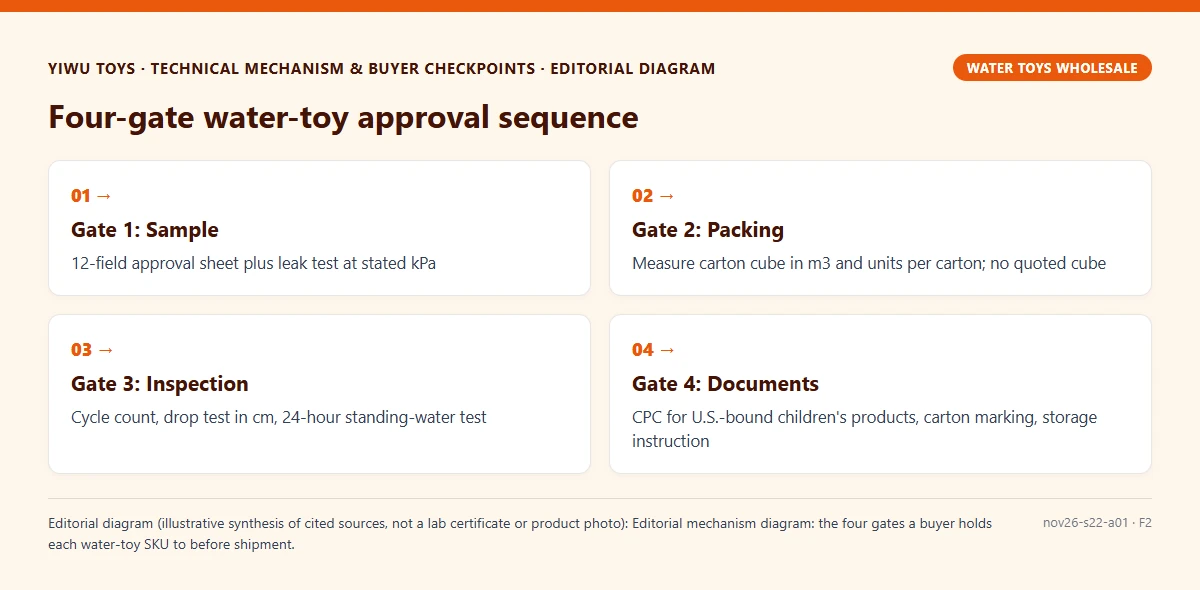
The approval sequence runs in four gates. Gate 1: sample with the 12 fields filled in and a leak test at the stated pressure. Gate 2: packing confirmation with carton cube measured, not quoted. Gate 3: pre-shipment inspection with a cycle count, a drop test and a 24-hour standing-water test on a sample lot. Gate 4: document check — CPC for U.S.-bound children's products, carton marking, and the retail-box storage instruction. Hold each gate to a written pass/fail line; a verbal 'OK' at Gate 2 is where cube surprises enter the freight invoice.
Which water-toy format is easiest to specify for a first 2027 order?
The pull-pump blaster has the fewest interfaces to define — three — and the lowest cube per unit at 2.5 L in the illustrative calculation, but its nozzle and pressure design must still be specified against projectile-safety concerns before sample approval. A first order of 1,000 blaster units occupies about 2.5 m3, roughly 3.7% of a 68 m3 high-cube container, which leaves room to test a second format in the same shipment.
Do zero-battery water toys avoid compliance work?
No. Removing batteries removes one failure mode, but U.S.-bound children's toys still fall under ASTM F963 as made mandatory by U.S. product safety documentation Section 106, so seal, material and small-parts specs still need third-party testing and a CPC for products primarily for children 12 and under. A 13+ product falls outside the CPC requirement but remains inside ASTM F963 scope.
How should drying and hygiene be written into the order?
Require a stated drainage point, a drying interval before packing in hours and a storage instruction per format. For a backpack tank that means a full-drain requirement and a drain-plug diameter; for a splash mat it means a lowest-seam drainage point and a fold-flat drying instruction; for a blaster it means a drain port and a vented polybag. Confirm each field per item and per carton configuration.
Build the 2027 water-toys shortlist on comparable fields
Start with the format mix the cube math supports: blasters as the volume driver at 2.5 L per unit, splash mats as the assortment anchor at 5.0 L, and backpack tanks reserved for a higher price tier at 6.0 L. Then convert each shortlisted item into the 12-field approval sheet and hold sample approval to the four gates. Browse the water and beach toys category to shortlist formats, and send the completed field sheet with each inquiry so every quotation answers the same questions.