
Expand a Yiwu mixed-carton toy assortment only when each added item justifies its own version and packing checks. A 53-piece go-kart building set adds construction play; a friction-powered fire-truck set adds vehicle play, but its interchangeable configuration needs clarification. For buyers sourcing yiwu toys, the larger shortlist adds RFQ work when items require separate quantity splits, packing configurations or shipping marks. Include distinct roles, hold unresolved versions, and drop duplicates whose packing burden outweighs their purpose.
Separate a mixed assortment shipped in several cartons from several products packed inside one carton. Combining an inquiry does not establish permission to mix products within an outer carton. That second arrangement needs its own item breakdown, packing layout and carton record.
Which Candidate Toys Should Enter the RFQ Round?
| 53-piece go-kart racing building set | Assortment role: construction play with a vehicle component. Catalog record: ABS plastic with a die-cast alloy car; color-box packing; reference MOQ 216 units; 72 units per carton. Proposed decision: INCLUDE in the RFQ because the construction-play role is distinct. Request: exact version and contents, whether the car is included in the stated 53 pieces, current quote and minimum quantity, color/version split, sample reference, and proposed outer-carton packing. Order approval condition: buyer accepts the version and packing specification. |
|---|---|
| 5-in-1 friction-powered fire-truck play set | Assortment role: friction-powered vehicle play with an interchangeable configuration. Catalog record: plastic; color-box packing; reference MOQ 108 units; 36 units per carton. Proposed decision: HOLD outside the full RFQ round until the supplier identifies exactly what one saleable set contains and explains the 5-in-1 configuration. Send a focused clarification request now. Hold closure: buyer reviews a contents list and matching version photographs or sample, then decides whether the set adds a distinct assortment role. |
Which Questions Change the Product and Packing Specification?
Ask questions that identify one saleable version before requesting a final carton plan; otherwise the supplier may be quoting a different set size or configuration.
For the included go-kart building set, send this short RFQ request: “Quote the 53-piece version with the die-cast alloy car. Confirm the complete contents, how the piece count is defined, the sample or version reference, color-box configuration, proposed order quantity and current minimum. State any differences between the quoted item and the sample. Provide the proposed closed outer-carton dimensions, units per carton, carton count, gross weight and net weight.”
For the held fire-truck set, resolve the mechanism question first: “Show the contents of one retail set, identify which vehicles or assemblies have friction action, and explain whether 5-in-1 means five included vehicles, five configurations, or another arrangement. Show the exact version being offered.” A clarification inquiry is appropriate while the shortlist is still being defined; a hold need not mean silence.
Combine both items into one supplier inquiry if practical, but keep separate product and packing lines. Shared color-box packaging is not evidence that they can use the same outer carton.
How Do Reference Quantities Translate Into a Proposed Carton Plan?
| Go-kart building set: planning quantity of 216 units | 216 units ÷ 72 units per catalog carton = 3 cartons, with no unit remainder. This result applies only if the supplier confirms that exact version and 72-unit packing configuration. |
|---|---|
| Fire-truck play set: planning quantity of 108 units | 108 units ÷ 36 units per catalog carton = 3 cartons, with no unit remainder. Keep this as a planning calculation while the product remains on hold; it is not an instruction to order. |
| A different quantity or a mixed-SKU carton | Request the actual packing breakdown, including any partial carton or mixed-carton arrangement. Do not automatically round the order upward or assume that surplus units must be purchased. |
What Packing Data Should Accompany Each Quoted Carton Configuration?
Request proposed packing data for each exact product version and carton configuration before fixing quantities, then replace estimates with final packed measurements before shipment.
Use this request: “Identify the product/version and packing revision. Give the proposed units per closed outer carton, item quantities for any mixed carton, total carton count, external length × width × height in centimeters, gross and net weight in kilograms, board and closure specification, internal protection, and shipping-mark artwork. Identify partial cartons separately.” Collecting carton dimensions, quantities and gross/net weights before confirming quantities also follows the published mixed-container planning guidance. How to Build a Mixed Container
Label this first record “proposed pre-PO packing.” It is a planning target, not evidence of the dimensions or weight of the finished shipment. Agree acceptable dimensional and weight variations with the buyer before inspection rather than treating every difference as a failed shipment.
Give each final carton configuration a revision and link it to the approved product version. A catalog measurement belongs only to its identified item and pack configuration; do not substitute retail-box dimensions for closed shipping-carton dimensions.
How Should the Closed Shipping Cartons Be Inspected?
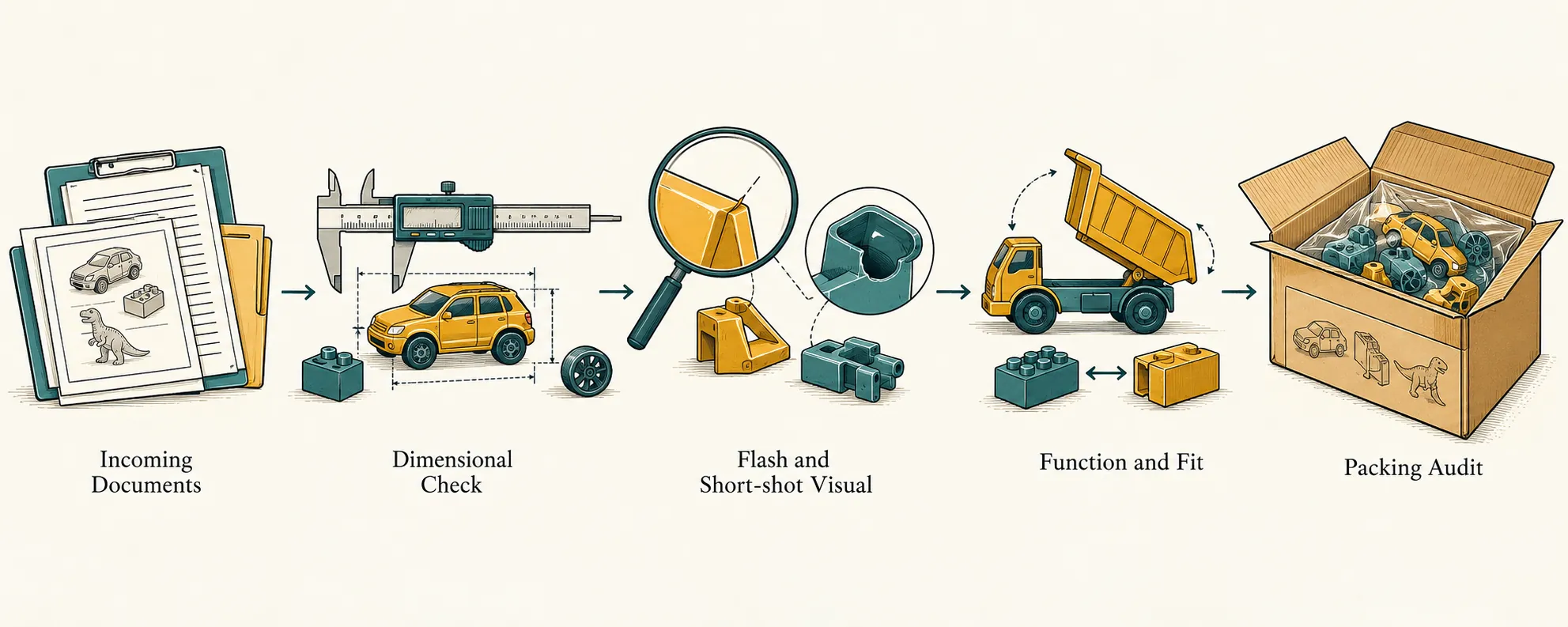
| 1. Carton identity and packing revision | Inspect: carton number, supplier/product reference and packing configuration. Compare with: approved packing sheet and carton-ID schedule. Discrepancy: a carton cannot be linked to the correct item, version or revision. Next decision: segregate the affected carton record and establish its identity before accepting its measurements or contents declaration. |
|---|---|
| 2. External dimensions and units | Inspect: length × width × height of the fully packed, closed carton, using consistent orientation and centimeters; include any bulge in the external envelope. Compare with: approved packing dimensions and buyer-agreed tolerances. Discrepancy: dimensions outside the agreed range, inconsistent units or an unexpected packing shape. Next decision: remeasure, confirm the configuration and recalculate CBM; approve a documented variation or require packing correction. |
| 3. Carton count and item quantities | Inspect: physical carton tally, carton IDs and declared item quantities. Compare with: order quantity, carton-level packing records and draft final packing list. Discrepancy: missing or duplicate carton IDs, unexplained partial cartons, or totals that do not reconcile. Next decision: resolve the packing records and correct the affected quantities or packing before approval. A sealed carton's label is not independent proof of its internal count; use packing/tally evidence linked to its ID. |
| 4. Gross and net weights | Inspect: closed-carton gross weight on a suitable scale, recorded in kilograms. Compare with: the approved gross-weight target, agreed tolerance and final packing list; reconcile net weight through the documented contents and tare basis. Discrepancy: unexplained weight variation or inconsistent gross/net definitions. Next decision: reweigh and investigate the packing or count records before updating the final weights. Net weight is not directly observed by weighing a sealed carton. |
| 5. Carton construction, condition and closure | Inspect: specified board/flute construction, reinforcement, tape or other closure, bulging, crushed corners, moisture damage and split seams. Compare with: approved carton construction and closure specification, plus any agreed packaging-performance evidence. Discrepancy: changed construction, failed closure or visible damage. Next decision: require correction or repacking and recheck. An intact appearance or a hand press does not establish compression strength. |
| 6. Shipping marks and carton labels | Inspect: legibility, placement, carton numbering, product references, quantities and any agreed barcode. Compare with: approved mark artwork, carton-ID schedule and final packing-list entries. Discrepancy: wrong item reference, duplicate number, unreadable code or mismatched declared quantity. Next decision: correct the marks and verify them again against the reconciled records. |
How Does a Carton Dimension Change Affect CBM?
Calculate CBM from final external dimensions, and review a dimensional change against the agreed tolerance and packing plan rather than rejecting it automatically.
Explicitly hypothetical example, unrelated to either catalog item: a proposed closed carton measures 60 × 40 × 35 cm. CBM per carton = L(cm) × W(cm) × H(cm) ÷ 1,000,000 = 60 × 40 × 35 ÷ 1,000,000 = 0.084 m³. For six identical cartons, total volume = 0.084 × 6 = 0.504 m³.
Suppose final measurement is 61 × 40 × 35 cm. The revised volume is 0.0854 m³ per carton, or 0.5124 m³ for six. Record both the specified target and observed measurement. Remeasure to rule out a recording error, confirm whether the packing changed, and check the buyer-agreed allowance. If accepted, record the variation and update the final packing data; otherwise correct the packing and measure again.
For several carton configurations, calculate each configuration separately and add the totals. One convenient carton size cannot stand in for an entire assortment.
What Closes the RFQ Screen and Carton Approval?
Close the RFQ screen when every candidate has an include, hold or drop decision, and close carton approval only when the final physical observations reconcile with the packing records.
Include an item when its assortment role is distinct and its remaining questions can be answered in the RFQ. Hold it when the version or set contents are too uncertain for a comparable quote. Drop it from this round when it duplicates a retained role and adds a separate packing configuration or unresolved question set without a clear buying purpose. A larger assortment need not create much extra work if additional items genuinely share an approved version and packing specification.
Keep a separate carton approval record containing the order and supplier reference, product/version, packing-sheet revision, carton IDs, specified targets, observed dimensions and weights, count evidence, condition and mark results. Reconcile the final carton and unit totals, weights, descriptions and marks with the final packing list—not just the pre-PO estimate.
Record the decision as approved, approved with stated conditions, or held for correction. Assign the responsible approver and decision date. Each open condition needs an action owner, due date, corrected evidence and closure sign-off. A conditional decision should state whether the affected cartons remain held until closure.
The record provides traceability; it does not independently reveal an undisclosed contents change. Keep product-safety approval as a separate release check, and keep destination-specific paperwork separate from this carton inspection.